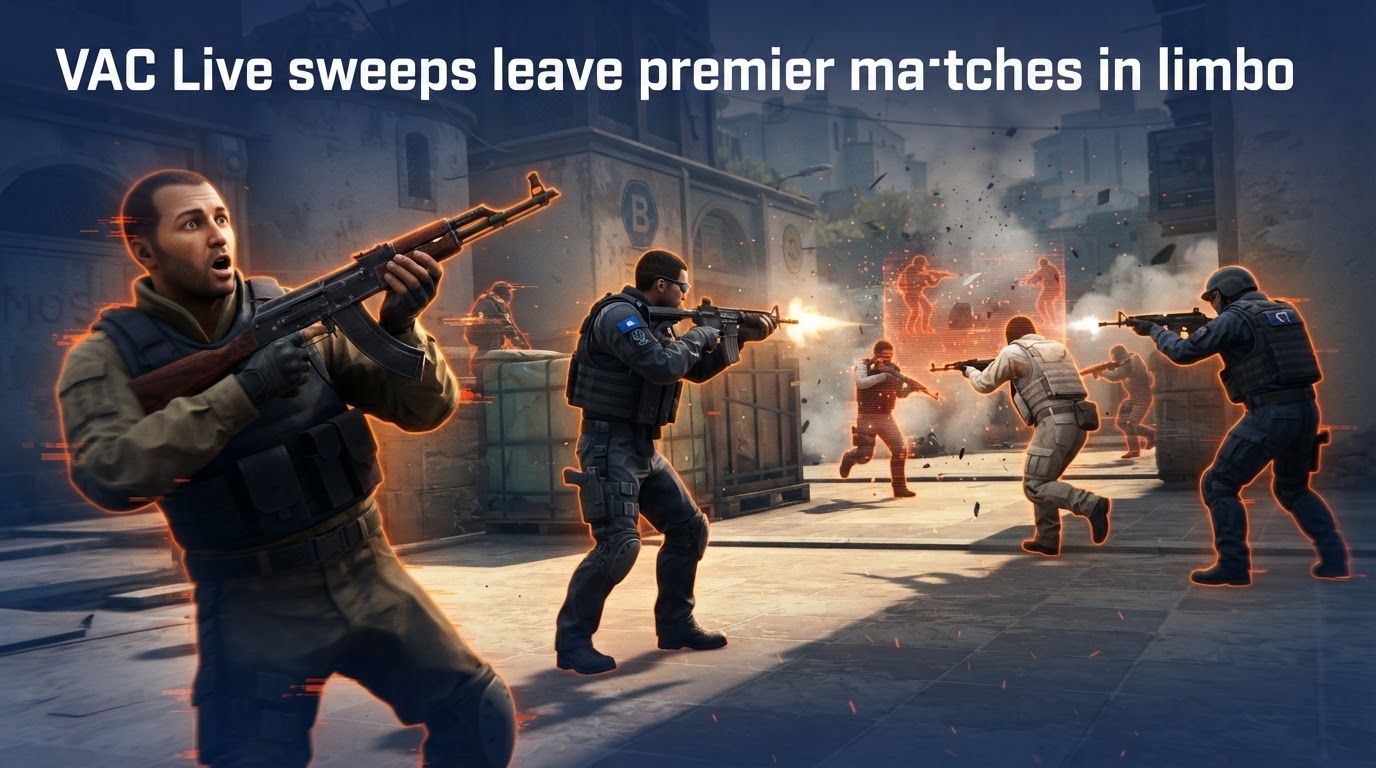
VAC Live sweeps are putting some CS2 Premier matches in limbo: a game can end before the normal win condition when Valve’s anti-cheat detects suspected cheating. For players who queue Premier for a clean competitive result, the immediate problem is not only the suspected cheater,it is the uncertainty around why a match stopped, what the cancellation means, and whether the same thing could happen again next queue.
The recent wave of community reports makes clear that VAC Live is highly visible again, but it does not provide a complete public view of every detection or every cancelled match. Valve designed VAC Live to live-ban players and terminate matches, while VacNet 3.0 testing and the reports surrounding it show that the anti-cheat approach in official CS2 matchmaking is still developing rather than standing still.
VAC Live sweeps in Premier: the direct answer
VAC Live can cancel a CS2 match mid-game when cheating is detected. In Premier, that can leave players without a conventional finish to the match. Recent October 2026 player reports indicate that cancellations are being noticed again, but individual reports do not establish how often they occur, why every cancellation happened, or whether a specific player was correctly detected.
That distinction matters. A cancellation message is not the same thing as a public case file, and it should not be treated as proof that any named teammate or opponent cheated. The useful takeaway for a player is simpler: the match has been interrupted by an anti-cheat action, and the right next step depends on whether the cancellation appeared normal or looked accidental.
Valve’s June 6, 2023 CS2 update established the core behavior. As reported by HLTV, VAC could live-ban players and terminate matches. This was not presented as an ordinary disconnect, surrender, or server crash mechanic. It was an anti-cheat response designed to stop a compromised game from continuing.
Why Premier matches can feel stuck in limbo
Premier is built around a competitive match being played through to a result. When VAC Live terminates that match, it breaks the familiar flow: there may be no final round, no ordinary post-match story, and no satisfying sense that the players decided the outcome themselves.
That interruption is why the feature produces two very different reactions at once. Players who believe a cheater has been removed can see a live cancellation as a welcome sign of enforcement. Players in a close, legitimate-feeling match can experience the same event as an abrupt loss of time and momentum.
A cancellation resolves one problem but creates practical questions
- Competitive integrity: Ending a match can prevent a suspected cheater from continuing to influence more rounds.
- Match closure: Players may be left without the conventional finish they queued for.
- Rating uncertainty: Community posts about cancellations do not, by themselves, document a universal rule for how every affected Premier result is handled.
- Player trust: A visible response can reassure players that action is happening, but unexpected cancellations can also make the system seem opaque.
It is tempting to fill in the missing details from a single match experience. That is usually where confusion begins. A player may assume that a cancellation guarantees a ban for the person they suspected, or that it proves a particular account was cheating. The available facts support a narrower conclusion: VAC Live is capable of live bans and match termination, and players are seeing cancellation notices in Premier again.
For the community, the limbo is therefore partly competitive and partly informational. The game ends, but the public evidence available to ordinary players may not explain the detection, identify the account involved, or answer every question about downstream match handling.
What recent October 2026 VAC Live reports actually show
Recent Reddit discussions point to a renewed, unevenly perceived presence of VAC Live in Premier matchmaking. Posts dated October 9 and October 19, 2026 describe multiple cancellations, including claims that several games were cancelled over a short period and that “half” of some matches were cancelled.
Other threads show how surprising the feature remains. The October 10 post titled “VAC Live is cooking asf right now” is a clear example of players reacting to a cluster of live cancellations. On October 11, a post titled “FIRST TIME SEEING THIS MATCH CANCELLATION” captured the other side of the experience: for some players, the notice is still unfamiliar and unexpected.
Community interpretation is not uniform. One October 11 thread described a match cancellation shortly after a player was accused of cheating. A post from October 12 said VAC Live finally “works” after the poster returned to CS2. These reactions frame the system as a potential deterrent, but they remain player observations rather than official confirmation of the circumstances behind each event.
Reports also show that the impact is not consistent for every queue
A useful counterweight is the October 19 post titled “Played Eight Matches in Premier and I DID NOT get a VAC ban.” Its point is not that VAC Live is absent. Rather, it highlights why broad conclusions from one session can mislead: one player may encounter several cancellations while another sees none.
This uneven perception has several possible practical explanations that do not require guessing about individual accounts. Premier players are not all entering the same lobbies, regions, times, or runs of matches. More importantly, public player reports are a record of what people chose to share, not a complete measurement of the whole matchmaking population.
So the responsible reading of the October reports is that live cancellation activity is being noticed and discussed. They should not be converted into a percentage of Premier games, a claim about a specific detection rate, or a declaration that every cancellation was correct.
VacNet 3.0 explains why Valve treats false cancellations seriously
Valve’s anti-cheat systems are not presented in the available record as a finished, unchanging product. In August 2024, Valve introduced initial VacNet 3.0 testing on a limited set of matches. HLTV reported that Valve asked players to report cases where a match was incorrectly cancelled by emailing match details to Valve’s feedback address.
That request is important for two reasons. First, it acknowledges the practical possibility of an accidental cancellation during limited testing. Second, it gives affected players a constructive path that is better than treating a public accusation as an appeal process.
What the limited testing context does and does not tell us
- It shows that VacNet 3.0 testing was initially limited to a set of matches.
- It shows that Valve wanted reports of incorrect cancellations during that period.
- It does not establish that every later cancellation is an error.
- It does not establish the current scope of every VacNet or VAC Live deployment from player reports alone.
Players often want a binary answer: either the system is catching cheaters perfectly or it is cancelling legitimate games. The available evidence does not support either absolute. The more grounded view is that Valve has deployed live match termination as part of anti-cheat enforcement, has tested VacNet 3.0 in a limited context, and has explicitly sought feedback on accidental cancellations.
That is also why restraint is valuable in community discussion. A cancellation may feel like a verdict on a suspicious opponent, especially after a tense sequence of rounds. Yet the public match experience is not a transparent forensic report. Do not turn the cancellation screen into a reason to harass, name-and-shame, or make unsupported claims about another player.
How to respond when VAC Live cancels your CS2 match
The best response is practical: preserve the relevant details, avoid assumptions, and decide whether the event looks like something Valve should investigate. This applies whether you were convinced some was cheating or were surprised because the game seemed ordinary.
- Record the match details. Note the approximate time, map, and any match information available to you. A screenshot of the cancellation notice can help preserve what you saw.
- Check your own connection and client situation without conflating it with VAC Live. A cancellation notice is different from an ordinary disconnect, but keeping track of what happened on your end makes any later report clearer.
- Do not accuse a specific player as a fact. You can report suspicious gameplay through the game’s normal channels, but the cancellation itself does not give players a public explanation of the detection.
- Report an apparent accidental cancellation to Valve with match details. Valve previously directed players to email match details to its feedback address when a match was incorrectly cancelled during VacNet 3.0 testing.
- Watch for official updates. Patch notes and Valve communications carry more weight than conclusions drawn from a single screenshot or Reddit thread.
This approach protects both sides of the competitive experience. If a real cheat was detected, the match was stopped rather than allowed to continue. If players believe the cancellation was incorrect, detailed feedback is more useful than vague frustration because it gives Valve something tied to the specific match.
What players should not assume about a cancelled Premier game
Anti-cheat discussions often become unreliable when players infer mechanics that have not been publicly explained. With VAC Live sweeps, several assumptions are especially worth avoiding.
- Do not assume every cancellation identifies the player you suspected. The available facts do not provide a public account-by-account explanation for each match termination.
- Do not assume a cancellation proves every unusual play in the match was cheating. Suspicion, a report, and an anti-cheat action are different things.
- Do not assume one session represents all of Premier. October 2026 reports range from repeated cancellations to a player reporting eight matches without one.
- Do not assume that community titles or comments are official Valve statements. They are valuable signals of player experience, but they are not system-wide data.
- Do not invent an MMR, rating, or penalty outcome. If Valve has not publicly defined the handling for the exact situation, presenting a theory as a rule will mislead other players.
These limits are not excuses for poor anti-cheat performance, nor do they dismiss the frustration of a cancelled match. They are the line between documenting what happened and claiming to know the hidden decision behind it. A healthy CS2 community needs both: pressure for clear systems and discipline about evidence.
The trade-off: faster anti-cheat action versus a clean match finish
Live enforcement changes the usual anti-cheat trade-off. A delayed ban can allow a suspicious player to finish a match and potentially affect the result before action occurs. A live ban and cancellation can stop the suspected harm immediately, but it also interrupts nine other players who expected to complete the game.
For many competitive players, stopping an active cheater is preferable to playing out a tainted Premier match. That is the strongest case for VAC Live. The October 2026 posts that celebrate the system “working” reflect a desire for visible action rather than a sense that reports disappear into a black box.
The cost is predictability. Players want to know what happens to the time invested, the competitive result, and the integrity of a match that ends suddenly. When explanations are limited, even a legitimate intervention can create confusion. That does not mean live cancellation is the wrong approach; it means the player experience depends heavily on clear communication and reliable operation.
Alternatives are not consequence-free
The apparent alternative,letting every match continue and dealing with suspected cheaters later,would avoid mid-game cancellations. But it would also leave the suspected player in the server for the rest of that game. A purely delayed model may feel less disruptive in the moment while doing less to protect the ongoing match.
Conversely, an aggressive live system can be effective only if it earns trust through accuracy and a credible route for feedback when something goes wrong. Valve’s 2024 request for reports of accidental cancellations shows why that feedback loop matters. The central challenge is not choosing between player comfort and competitive integrity as if only one matters; it is reducing cheating without making legitimate Premier play feel disposable.
Premier uncertainty sits within a wider changing CS2 competitive environment
The October 2026 VAC Live conversation is happening during a period of wider uncertainty around Valve systems and competitive rules. HLTV’s October 2026 archive includes multiple Valve-related updates and discussion pieces, including VRS rule changes and ranking updates. For players who follow both Premier and the professional scene, that broader pace of change can make each cancellation feel like part of a larger moving target.
It is useful to separate these subjects. VRS rules, rankings, and Premier match cancellations are not interchangeable mechanics. Still, they share a practical effect on the community: players are trying to understand systems whose rules and behavior can evolve over time.
That context is especially relevant for content creators, team captains, and friends who regularly queue together. Avoid presenting an old explanation as permanent policy. When discussing a cancellation, identify whether you are describing an official update, a reported player experience, or your own interpretation. That small habit prevents a lot of misinformation from spreading through Discord servers and social feeds.
What to watch next with VAC Live and CS2 anti-cheat
The next meaningful signals will be official communications and repeatable evidence, not the loudest individual clip. Valve patch notes, formal anti-cheat messaging, and guidance on match handling would clarify more than any isolated Premier cancellation can.
Community reports still have value. They can show when a feature is suddenly being noticed across multiple players, as the October 2026 discussions did. They can also surface apparent edge cases that deserve attention. Their limit is that they cannot independently confirm the exact reason for every VAC Live action or measure the system’s overall accuracy.
For players, the practical standard is straightforward: welcome visible enforcement against cheating, document apparent mistakes carefully, and keep claims proportional to the evidence. That stance supports fair matches without turning uncertainty into rumor.
VAC Live sweeps leave Premier matches in limbo because they prioritize ending a potentially compromised game over delivering the normal finish players expect. Valve has supported that capability since 2023, VacNet 3.0 testing showed that accidental cancellations were a feedback concern, and October 2026 reports suggest players are seeing live cancellations again.
Until Valve provides more detail on a given event, treat the cancellation notice as evidence that the match was stopped,not as a license to declare who cheated or what rating outcome must follow. Save the details, report an apparent erroneous cancellation through the channel Valve specified, and rely on official updates when deciding what the change means for your next Premier queue.