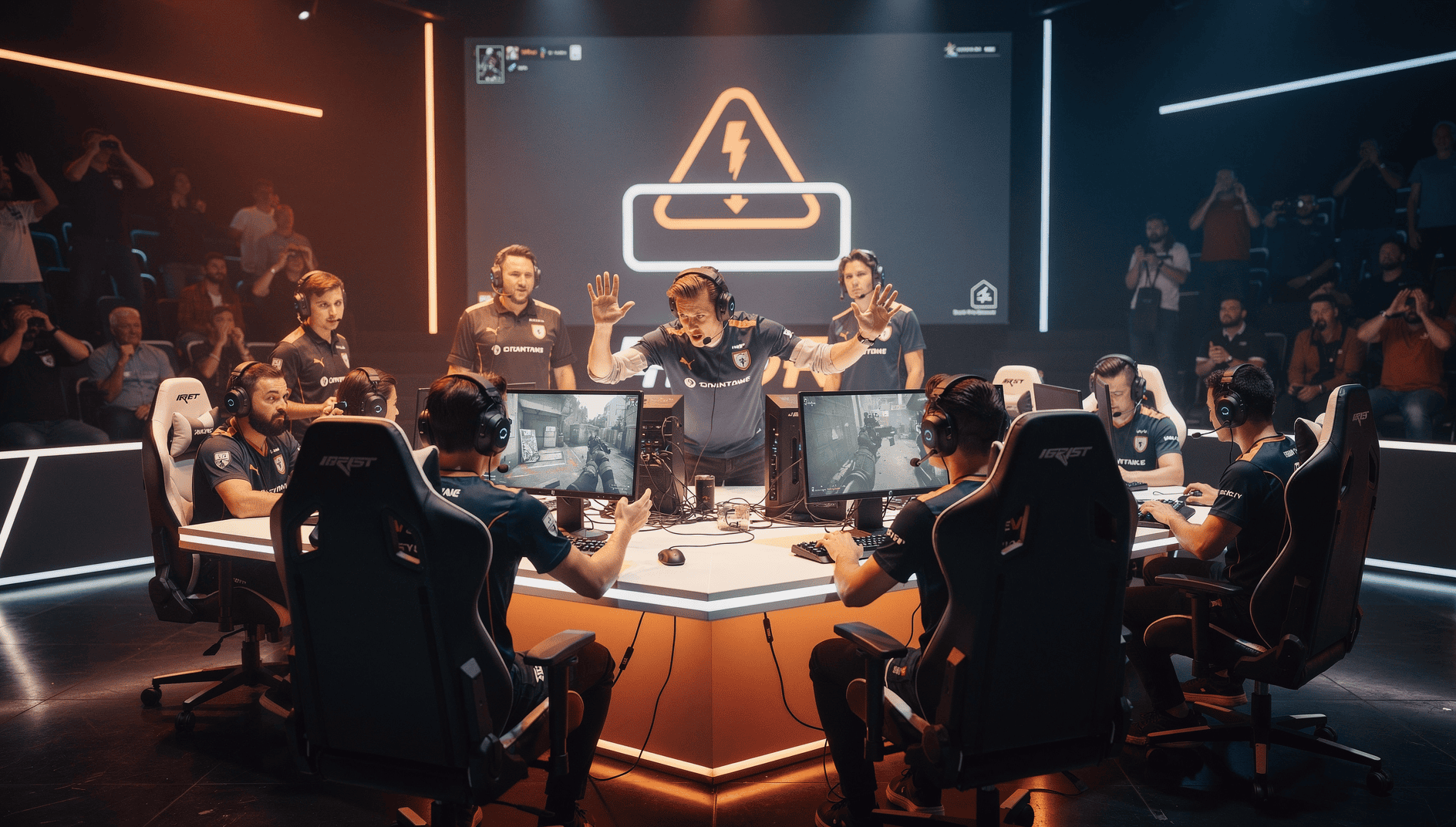
A competitive session can fall apart long before a player loses aim, confidence, or focus. Server updates that look minor on a status page can change queue behavior, introduce latency spikes, delay registered actions, or end a live match with no recorded result,each of which breaks the rhythm players rely on to perform consistently.
For Counter-Strike players, the practical lesson is not that every rough game is caused by the servers. It is that backend stability, matchmaking behavior, and maintenance decisions are part of competitive integrity. Recent updates and incident reports across live-service games show why teams, solo queue players, tournament organizers, and community servers need to treat a “small fix” as a possible competitive event until its effects are understood.
How server updates disrupt competitive rhythm
Direct answer: Small server updates disrupt competitive rhythm when they alter the timing or reliability of systems players depend on: matchmaking, server response, action registration, lobby entry, and match persistence. Even if gameplay mechanics do not change, a brief queue swing, latency spike, or forced shutdown can affect warm-up, team coordination, rank progress, and confidence in the result.
Competitive rhythm is the repeatable pattern that lets players get into the right state for a match. It includes practical details,finding teammates, entering a lobby, connecting to a server, warming up, and playing through a full map,as well as less visible factors such as trusting that shots, movement, utility, and reconnects will behave predictably.
That rhythm is fragile because competitive games are interconnected services rather than isolated matches. A player may only see a delayed queue or a stuttering round, while the underlying change may involve server capacity, a matchmaking service, a database, or the process that moves players from a lobby into a game.
“The minor fluctuation you see just after 16:00 PT was caused by a small server update we deployed at that time.”
Apex Legends shared that explanation for a visible matchmaking fluctuation on February 26, 2026. The example matters because it describes the central problem clearly: a routine backend deployment can have a noticeable player-facing effect even when it is small in engineering scope.
For a CS2 player, the equivalent experience might be a queue that suddenly slows, repeated difficulty joining a server, an unusual number of canceled lobbies, or a match that feels inconsistent during a period when no client patch has appeared. The visible symptom alone does not prove the cause, but it is reasonable to check whether official service information or community reports point to wider instability before treating the session as normal ranked play.
Why server performance is a competitive integrity issue
Server performance is often described as an uptime concern: either the game is available or it is not. Competitive players need a more demanding standard. A service can be online while still creating an uneven playing environment through inconsistent latency, failed state updates, slow lobby transitions, or poor match composition.
EA’s matchmaking testing illustrates the point. The company said its tests had a positive impact on match quality and produced much fewer skill mismatches. It implemented the change globally on May 7, 2026, after observing the trade-off between queue times and fairer matches.
That trade-off is important. Faster matchmaking is valuable, especially for players with limited time or for regions and modes with smaller populations. But fast queues are not automatically better queues if they repeatedly create imbalanced games. A more competitive matchmaking approach may accept some additional waiting in exchange for a more credible contest.
Fairness is more than low ping
Low latency is vital in a tactical shooter, but it is not the only server-side fairness question. Competitive integrity also depends on whether the service can reliably create suitable matches, maintain game state throughout a round, and preserve results when a match concludes.
- Match quality: Are players being placed into contests that make competitive sense rather than frequent severe skill mismatches?
- Action reliability: Do inputs and game actions register consistently enough for outcomes to reflect decisions and execution?
- Match continuity: Can players join, reconnect, and finish a game without avoidable service interruption?
- Result integrity: If service work forces a match to end, is there a clear and consistent policy for draws, stats, ranks, and records?
Players sometimes frame these problems as separate annoyances: bad queues, laggy servers, a lost game, or missing progress. In practice, they are connected. All can undermine the expectation that a competitive result came from play rather than from the live-service layer around the game.
This does not mean that an imperfect match proves manipulation or that every skill mismatch is a technical fault. Matchmaking has unavoidable limits, particularly when player populations, party sizes, regions, and queue times pull in different directions. The point is that backend choices influence the conditions under which competition happens, so they deserve the same scrutiny players give to anti-cheat, map balance, and rules enforcement.
Latency spikes and failed actions break the moment-to-moment game
The most immediately damaging update problems are not always full outages. They are the unstable periods where the game technically remains playable, but the connection is no longer reliable enough to support high-stakes decisions.
Ingress’s May 16, 2026 debrief described “severe server latency, game actions failing to register, and general Scanner instability.” Although Ingress and Counter-Strike have very different gameplay, the operational lesson translates directly: when server-side state is delayed or actions fail to register, a live competitive experience stops being dependable at the exact moments players need precision.
Why these problems feel worse in serious sessions
Competitive play depends on timing. In Counter-Strike, a late update to player position, weapon fire, utility use, or a reconnect can change a round that would otherwise have been winnable. Even when the eventual result is technically correct from the server’s perspective, inconsistent responsiveness can make decisions feel disconnected from what a player saw and attempted.
The damage also extends beyond a single fight. A player who encounters unexplained delay becomes less willing to take timing-based duels, make aggressive rotations, or trust a fast utility sequence. Teammates may begin second-guessing calls because they cannot tell whether a missed action was a player error, a connection issue, or a broader service problem.
Blizzard forum posts from 2026 similarly described major latency spikes in the first minutes of matches after recent updates. Player reports are not the same thing as a confirmed root-cause analysis, but they matter as an early signal. When many players describe the same timing and symptom after an update, developers and community managers have a useful pattern to investigate.
Players should avoid assuming that every spike is a game-wide incident. Home network congestion, Wi-Fi quality, routing, background downloads, and local hardware can all affect performance. The useful distinction is whether the issue is isolated to one setup or repeats across teammates, regions, lobbies, and player reports at the same time.
A practical check before blaming your aim
- Note the exact symptom: high ping, packet loss, failed lobby join, delayed actions, disconnects, or unusually slow matchmaking.
- Check whether teammates experience the same behavior in the same match or queue window.
- Look at official game or platform status channels before relying on rumor posts.
- Compare another server, mode, or connection path if doing so is practical and does not risk abandoning a live competitive game.
- Save relevant evidence, such as a short clip, error message, approximate time, and region, if the issue is persistent enough to report.
This process will not solve an active incident, but it helps players make better decisions. It separates a potentially widespread competitive problem from a local one and gives support teams information that is more actionable than “servers feel bad.”
Small infrastructure changes can create large queue problems
Not every disruptive update directly changes the game server handling a live match. Some affect the supporting systems that feed players into games, store state, or manage the volume of requests around matchmaking.
Ingress attributed one instability event to “write contention gridlock” after a database change. In plain terms, a change intended for one part of the system created a bottleneck around competing database writes. This is a useful warning for players and community operators: infrastructure work can produce cascading effects even when the game’s visible rules, maps, weapons, and client build have not changed.
EA’s community update described another cascading failure mode. When matchmaking systems crash, players accumulate in queue, and “once it reaches a certain size it overloads the database.” A small initial disruption can therefore become a much larger problem: queues grow, recovery becomes harder, and more players encounter the issue at once.
The queue is part of the match experience
It is tempting to treat matchmaking as dead time before the real game begins. Competitive players know otherwise. Queue length affects when a stack can scrim, whether friends can fit in a session, how long a solo player can wait before tilting, and whether a team reaches a tournament check-in or scheduled practice on time.
Queue instability also changes player behavior. People may repeatedly cancel and restart searches, split a party, switch modes, or give up and play elsewhere. Those reactions can add more churn to a system that is already struggling, although players should not be blamed for trying to get into the game.
- A sudden matchmaking fluctuation can interrupt a warm-up schedule.
- Repeated lobby failures can split a regular group across different matches.
- Long queues can pressure players to accept a less suitable region or mode.
- Recovery after a queue failure can be uneven, leaving some players in quickly while others remain stuck.
For competitive communities, this is why transparent status communication matters. A concise acknowledgment that matchmaking is unstable is more useful than silence when players are trying to decide whether to wait, practice offline, run a community server, review demos, or reschedule a session.
Maintenance windows can change results without a software bug
Not every server-side disruption is an accident. Planned maintenance can deliberately interrupt active games, and that makes timing and communication part of the competitive decision.
Riot’s service status system has reported a scheduled shutdown where “all games currently in progress will end in a draw and stats will not be recorded.” That policy is clear: the service work takes priority, and the competitive record of affected games is not preserved. For someone in a close ranked match, however, the impact is still real.
The key distinction is between fairness of policy and convenience of outcome. Ending active games in a draw may be more consistent than allowing a partial service failure to decide who wins. Yet it still removes time, momentum, and potential progress from everyone involved. A transparent rule does not eliminate frustration, but it does reduce uncertainty and makes the outcome easier to understand.
What players can do around scheduled server work
Competitive players cannot control maintenance schedules, but they can reduce unnecessary exposure. If a status page identifies a planned shutdown window, avoid starting a long ranked session or a coordinated team activity too close to it. This is especially useful for stacks that need everyone present, players protecting limited time, and organizers running community events.
For a Counter-Strike team, an alternative plan can preserve the session: schedule aim training, utility practice, demo review, theory discussion, or a local/community-server session during the expected disruption. These are not substitutes for an official competitive match, but they keep a practice block productive when live services are uncertain.
Organizers should also build a simple contingency rule into smaller events. If the relevant platform has announced maintenance or instability, define whether matches pause, reschedule, move to a different approved server arrangement, or wait for service confirmation. The right choice depends on the event rules and available infrastructure, but deciding only after a live interruption usually creates avoidable disputes.
Why deploy, observe, and retune is now normal live-service work
Players understandably want a server fix to be final: deploy it, remove the problem, and move on. Modern competitive services rarely work that neatly. Real player traffic, regional conditions, party behavior, and unexpected system interactions can reveal effects that internal testing did not fully expose.
Ingress noted that after collecting field performance data, it would “further tune these temporary XMP adjustments.” That sequence,make a change, observe real-world performance, then tune or roll back where needed,is increasingly common. It is not automatically evidence of poor engineering; it is a practical response to systems that are complex and live.
The important question for players is how that process is handled. Responsible post-update triage should prioritize the actual competitive symptoms players encounter: queue failures, severe latency, action registration problems, match persistence, and unusually poor matchmaking. It should also communicate enough information for players to make sensible choices about whether to queue.
What good update communication looks like
Official teams do not always have a complete diagnosis immediately. They should not pretend otherwise. But even an early message can be useful when it identifies the affected service, the observed symptom, and the fact that the issue is being monitored or investigated.
- Clear scope: Is the issue related to matchmaking, game servers, login, lobby entry, or a particular region?
- Visible player impact: Are players likely to see slow queues, dropped games, delayed actions, or disrupted match joining?
- Operational status: Is the team investigating, rolling back, tuning, or monitoring after a fix?
- Result policy: If active matches are affected, what happens to draws, stats, progression, or competitive records?
Battlefield community communications on October 2, 2026 acknowledged a new issue message during match joining while saying gameplay remained unaffected. That is a useful example of separating lobby-flow friction from confirmed in-match impact. Players still need to know about the message, because match entry is part of the experience, but the communication avoids overstating the gameplay consequence.
Emergent Interactive’s September 2026 status log also recorded short outages. Brief interruptions can appear insignificant in aggregate reporting, yet they can matter greatly to the players trying to start a final match before work, keep a five-stack together, or complete a scheduled competitive series. Duration is only one measure of impact; timing and context matter too.
How Counter-Strike players can protect a competitive session
Players cannot fix a platform’s database contention or reverse a problematic deployment. They can, however, make their own sessions more resilient and avoid turning a known unstable period into a higher-stakes problem than it needs to be.
The goal is not to obsess over every status update. It is to build a lightweight routine that respects how much server conditions can influence competitive rhythm.
Before queuing
- Check official status channels when there has been a recent update, widespread community discussion of lag, or obvious trouble joining games.
- Confirm that your own connection is not under unusual load from downloads, streaming, cloud backups, or other household activity.
- For a full stack, agree on the preferred region and on what the team will do if repeated connection or queue problems appear.
- If the session is important, such as team practice or a community match, keep a fallback activity ready rather than forcing ranked games through unstable conditions.
During an unstable window
Do not make decisions based on a single odd round. Look for a repeatable pattern: multiple players experiencing similar delay, repeated failed joins, consistently abnormal queue behavior, or corroboration from an official status page. If the pattern is clear, stepping away from ranked play can be the more competitive choice, not a loss of commitment.
Teams should communicate the symptom precisely. “I am getting delay on utility and movement around this time” is more useful than “the server is broken.” Clear information helps teammates decide whether a tactical adjustment is needed, whether a pause or report is appropriate under the event rules, and whether the group should end the session.
After a disrupted match
Save evidence if a report is warranted, but keep expectations realistic. A clip and accurate timing can help establish a pattern; they do not guarantee an individual result will be changed. Follow the game’s official support and competitive procedures rather than relying on social posts as a substitute for a report.
It is also worth separating technical frustration from performance review. If a match had clear server instability, do not use it as the only evidence for a roster judgment, role change, or conclusion that a player “choked.” Review what can be reviewed, acknowledge what was unreliable, and avoid building team narratives around a session that did not provide stable competitive conditions.
What recent server incidents tell us about competitive games
The recurring pattern across EA, Riot, Blizzard, Ingress, Battlefield, and other live-service status updates is straightforward. Teams deploy changes, monitor live effects, respond to latency or queue problems, and retune when field conditions reveal new issues. Competitive games are increasingly operated as real-time services, and the operational layer has become part of the competitive environment.
That does not justify preventable disruption, nor does it mean players must accept every unstable session without criticism. It means the best standard is practical and transparent: make changes carefully, communicate meaningful player impact, protect result integrity where possible, and react quickly when a fix produces new friction.
For players, the strongest response is equally practical. Watch for verified signals, distinguish local trouble from broader incidents, avoid treating unstable queues as normal ranked conditions, and keep an alternative plan for valuable team time. Small backend fixes may never be glamorous, but their effect on queue flow, match fairness, and player confidence can be enormous.
Competitive rhythm is built from reliable repetitions: queue, connect, communicate, execute, finish, review. When server updates interrupt that chain, the issue is not merely technical. It is a disruption to the conditions that let players compete on merit.