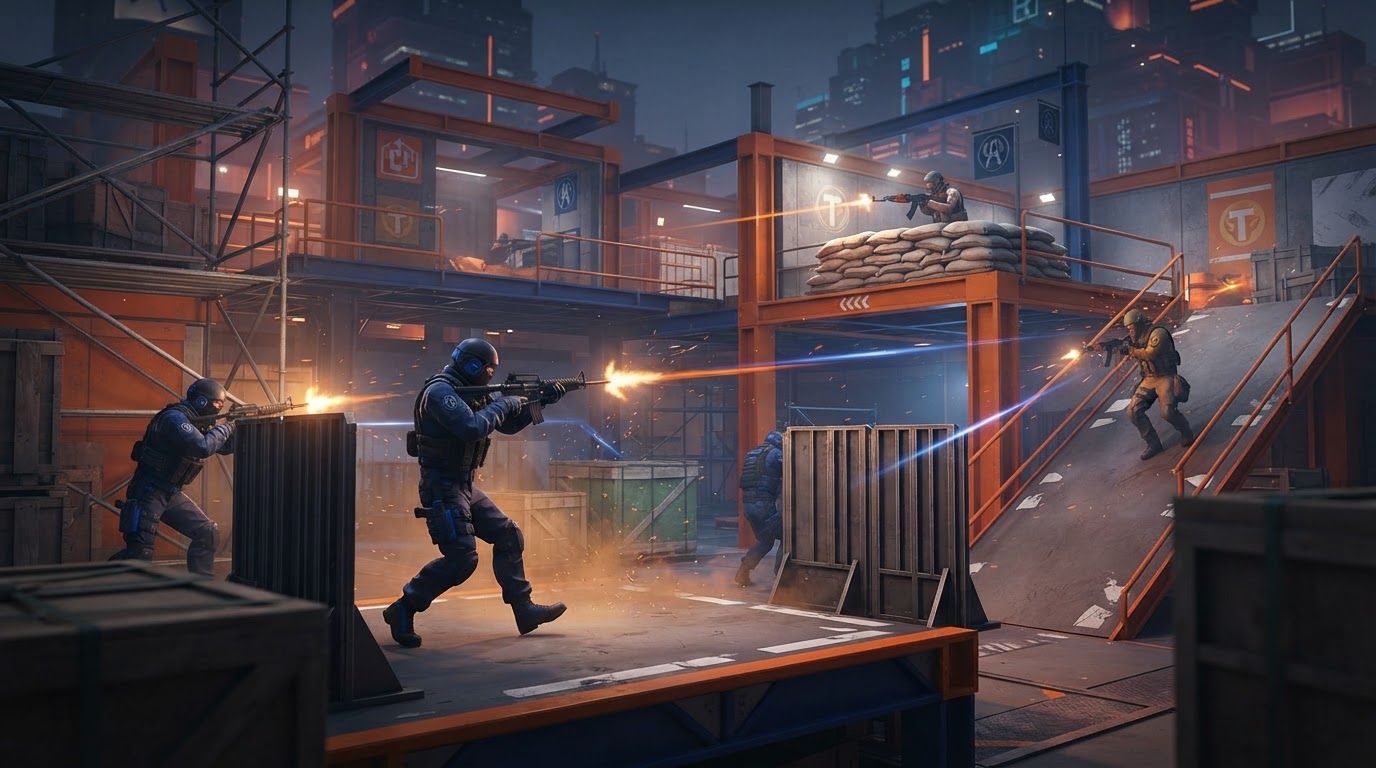
New scripting tools are making community-made Rush arenas more practical to build, test, and share,but the opportunity is not the same in every game. For Counter-Strike players, the important lesson is that arena design is moving beyond a single static layout: scripting can connect multiple combat rooms, manage match flow, shape bot behavior, and turn a map into a repeatable server experience.
The current wave spans Battlefield REDSEC’s Portal Next, Counter-Strike 2’s arena-oriented Rush setup, Refrag’s training tools, and creator-focused platforms such as s&box. These tools do not remove the work of good level design or moderation, but they lower the barrier between an idea for a duel, retake, aim, or objective arena and a playable community mode.
What new scripting tools mean for community-made Rush arenas
Community-made Rush arenas are custom combat spaces where scripts control more than doors, spawns, and scoreboards. They can define the round sequence, select an arena, assign teams, constrain movement, alter combat rules, run win conditions, and return players to a hub before the next encounter.
Direct answer: New scripting and level-editing tools let creators build Rush-style experiences as systems rather than one-off maps. A single project can contain multiple arenas, shared logic, custom rules, training scenarios, and a publishing path for community play.
That distinction matters. A well-made arena has always needed readable sightlines, intentional cover, sensible spawn positions, and a clear combat purpose. Scripting adds the layer that decides when players use an arena, what rules apply there, and how the experience transitions from one encounter to another.
Valve’s Counter-Strike 2 Rush scripting setup illustrates this model especially clearly. The documented setup supplies the mode entry, configurations, a team introduction, bot behavior, and generic entities, while the map itself contains separate arenas and a hub room used for logic entities. Rather than treating every fight as a separate map, a creator can make one modular package that cycles players through distinct combat spaces.
The same documentation describes rush_001 as one map containing 19 separate arenas plus a logic hub. That is a useful example of scale, not a promise that every community project needs 19 rooms. A smaller project with two or three sharply defined encounters is often easier to test, tune, and explain to players.
Why CS2 Rush scripting favors modular arena design
For CS2 creators, the most interesting part of the Rush model is its separation of responsibilities. The gameplay framework handles broad mode-level needs, while the map holds the rooms and the logic that connects them. This encourages creators to think in modules: a warm-up hub, a pistol arena, a mid-range rifle arena, a utility-focused room, and perhaps a final high-pressure encounter.
A hub can do more than fill downtime
A hub room is not merely a waiting area. In an arena-based design, it can be the place where logic selects the next room, resets players, moves teams into position, presents instructions, or provides a short pause between rounds. Keeping shared logic near the hub can also make a complex map easier to reason about than scattering essential control entities across every combat area.
The practical benefit is iteration. If one arena produces frustrating spawns or a dominant angle, a creator can revise that room without abandoning the entire mode concept. Modular construction also makes it possible to add new arenas later while preserving the familiar core loop.
Different rooms can test different CS skills
- Close-range aim rooms can emphasize reaction speed, movement, and rapid target acquisition.
- Mid-range dueling rooms can reward crosshair placement, counter-strafing, and disciplined peeking.
- Utility scenarios can focus on grenade timing, space creation, or retake decisions.
- Objective-oriented arenas can create pressure around a plant, defuse, hold, or rotation choice.
- Mixed-skill rounds can combine movement paths, verticality, and a clear tactical decision rather than simply adding more opponents.
None of these concepts automatically produces a good custom map. An aim room with poor spawn protection remains frustrating, and an objective room without readable routes becomes confusing. The script should support the arena’s intended decision-making, not cover up a layout that players cannot understand.
From a map idea to a playable custom Rush mode
The most reliable workflow starts with the player loop rather than a giant layout. Before building assets or writing a large rules script, define what happens from the moment a player joins until they complete one cycle. This is where many community projects become more manageable: creators stop trying to make every possible mode and instead make one repeatable activity work.
- Choose one core activity. Decide whether the mode is a fast duel sequence, a team Rush experience, a training ladder, a retake-style challenge, or another focused format. Players should be able to understand the purpose quickly.
- Sketch the loop. Write the order in plain language: join hub, receive team or loadout, enter an arena, play the objective or fight, resolve the round, then return or advance. If the loop is unclear on paper, scripting it will be harder.
- Build one representative arena. Make the first room prove the concept. It should include the main spawn logic, reset behavior, win condition, and any special movement or rule changes required by the mode.
- Put reusable behavior in shared logic. Team setup, introductions, bot behavior, general configuration, and transitions are candidates for shared systems. This keeps repeated rooms from becoming needlessly inconsistent.
- Test the edge cases. Check what happens when a player joins late, leaves, fails an objective, reaches an unexpected area, or encounters a round reset. Arena modes feel polished when these ordinary situations are handled cleanly.
- Add rooms only after the loop works. Expand through distinct arenas with a reason to exist. Variety should create new choices or skill tests, not just new scenery.
This approach applies even where the exact toolset differs. Battlefield REDSEC’s Portal Next makes Rush available at launch for community-made experiences and includes custom gameplay logic scripting and level editing. Refrag uses a different context,custom training and combat setups,but the same production principle applies: first establish the activity, then build content around a dependable loop.
Refrag’s Creator Studio explicitly says creators can create, save, and publish custom training modes. Its .addarena command gives creators a direct starting point for arena construction in developer mode. For players who want targeted practice rather than a full custom server mode, that focus can be an advantage: the tool is centered on creating a useful combat or training setup and sharing it with others.
Publishing turns custom arena scripting into a community feature
A custom arena only becomes community content when other players can find it, understand it, and return to it. Publishing is therefore part of the design process, not an afterthought. A mode with excellent scripting but no clear route to discovery will have a harder time building a player base.
Refrag provides a concrete example of the connection between creation and distribution: its guides describe publishing sets to the Community Hub. That creates a path from an arena idea to a shareable training package. In the Battlefield ecosystem, recent reporting has highlighted scripting, level editing, and community server discovery as central parts of the Portal-style direction.
Prepare a project for other players
- Name the experience clearly. Tell players whether they are joining Rush, aim training, a duel rotation, an objective drill, or a free-for-all combat space.
- Explain the rule that is different. If rounds rotate rooms, loadouts are fixed, or an objective changes the normal expectation, say so before players enter.
- Start with a short first session. Players are more likely to try a custom mode when they can quickly reach meaningful combat and understand the loop.
- Use consistent visual signals. Spawn areas, exits, objectives, safe zones, and interactive elements should not require guesswork.
- Collect specific feedback. Ask where players spawned, got lost, felt trapped, or found an angle too strong. “Did you like it?” rarely produces actionable map feedback.
Community distribution also creates responsibility. EA’s REDSEC guidance notes that custom experiences can trigger moderation flags through either the Rules Editor script or a Portal SDK map. That detail is important because it shows scripting is not a detached technical layer: custom logic and map content both affect whether an experience is suitable for publication and play.
Creators should treat moderation requirements as an early design constraint. Keep the mode’s purpose legible, avoid building features that depend on unclear loopholes, and review both the map and the script before sharing. A publishable arena is not simply one that runs; it is one that can be understood, reviewed, and safely encountered by a wider community.
How scripting changes rules, movement, and replay value
Level editing creates the physical arena, but scripts create much of its identity. They can determine whether players are constrained by a mode’s movement rules, whether hitboxes scale, what loadouts appear, how objectives resolve, and which conditions advance the experience. That flexibility is the reason community arenas can evolve quickly without rebuilding every piece of geometry.
Challenge Rush provides a useful example of rule-level iteration. Its changelog includes scalable hitboxes and a Free Mode that removes mode-specific restrictions. These are not claims about CS2 or Battlefield features; they demonstrate the broader design value of scriptable arena systems. A creator can revise the rules of engagement directly, then assess whether the new rules improve clarity and fun.
Use rules to clarify the arena’s purpose
Scripts are most effective when they reinforce a clear premise. If the arena is intended to train fast entries, rules might shorten downtime and repeatedly put players into the same meaningful decision. If it is designed around controlled team combat, scripts can prioritize fair resets and reliable objectives over constant novelty.
There is a trade-off. More options can increase replay value, but every extra modifier creates another balance question. Changing movement, weapons, target sizes, or round conditions at the same time makes feedback hard to interpret. Players may not know whether a loss came from the arena layout, the rules, or an unfamiliar combination of both.
A disciplined creator changes one significant variable at a time. First validate spawns and routes. Then tune the objective. After that, test optional rule variants. This sequence is slower than piling on features, but it makes a community-made arena easier to debug and easier for returning players to learn.
Tools beyond Counter-Strike show the wider arena-creation trend
The Rush conversation is part of a larger shift toward accessible, creator-led game development. Battlefield REDSEC has positioned Portal Next around custom gameplay logic scripting and level editing. s&box promotes the ability for creators to write gameplay and custom editor tools with C#, alongside tools for shaders and map creation. Roblox continues to identify Lua availability as a key driver of content creation and engagement among its active programmer community.
These platforms are not interchangeable, and their languages, publishing rules, audiences, and technical limits differ. Still, they point in the same direction: more creators can build small, focused experiences without starting from a full game engine project. Recent academic discussion of platformized game development similarly describes a landscape in which virtually anyone can create and share small games, including community modes in the style of Bed Wars.
The demand is visible across old and new mod scenes. A recent Half-Life 2 arena mod page describes bespoke combat arenas, altered arena-shooter mechanics, and bot support. A recent FiveM release packages a complete PvP arena system with FFA, TDM, Showdown, rankings, and progression. Those examples show that arena scripting is not restricted to one competitive shooter community or one genre of creator tool.
For players, the important change is not that every custom arena will be equally polished. It is that more creators can prototype a combat idea, connect it to rules and progression, and give a community a way to play it.
That expansion also raises the standard for curation. When more modes are available, a server browser or community hub needs clear descriptions, reliable tags, active moderation, and player recommendations. Discovery is valuable, but it works best when players can distinguish a finished practice tool, an experimental map, and a long-running competitive mode.
Limits: scripting cannot replace fair level design or testing
Powerful scripting can make a basic prototype playable, but it cannot make poor combat spaces fair by itself. A bad spawn may still put players into unavoidable damage. A dominant elevation change may still overwhelm the intended route. A confusing objective remains confusing even if the script correctly detects success and failure.
For Counter-Strike audiences in particular, fairness is felt immediately. Players notice whether they have time to orient after spawning, whether sound and sightlines communicate danger, whether cover actually creates choices, and whether an opponent can hold an angle with little risk. These are level-design questions that need hands-on playtests.
Common mistakes in custom arena projects
- Building too much before testing: A large multi-arena map can hide a weak core loop until revision becomes expensive.
- Confusing complexity with depth: Multiple modifiers, routes, weapons, and objectives can dilute the one skill or decision the arena should showcase.
- Ignoring transitions: Teleports, resets, team assignment, and return-to-hub behavior are part of the player experience, not invisible technical chores.
- Testing only with the creator’s regular group: Familiar players often understand unstated rules that new players will miss.
- Publishing without instructions: A short explanation of goals, controls, and expected behavior can prevent a good mode from being dismissed after one confusing round.
Bot support can help with early validation where available, as seen in the broader arena modding scene, but bots are not a complete substitute for human tests. They may help reveal navigation or timing problems, while real players expose ambiguity, frustration, exploits, social behavior, and the skill gaps that define an arena’s long-term appeal.
The healthiest community-made Rush arenas are therefore iterative. Creators should expect to adjust rooms, shared logic, and rules after observation. A stable core gives players confidence; carefully tested updates keep the mode from becoming stale.
What players should look for in a new Rush arena
Players do not need to script a map to judge whether it is worth their time. The first few rounds usually reveal whether an experience has a coherent purpose. Look for a clear start, understandable objectives, consistent resets, and an arena layout that gives both sides meaningful decisions.
- Can you tell what the mode wants you to do within the opening moments?
- Does the arena give you choices about positioning, timing, or teamwork?
- Do spawns and transitions feel fair enough to keep playing after a loss?
- Are special rules communicated clearly rather than discovered through confusion?
- Does each additional room or round add a new challenge instead of repeating the same fight with different props?
For training-focused content, also ask whether the setup helps you practice something specific. Refrag’s emphasis on custom training modes and publishable sets points to a practical standard: a useful arena should let a player repeat a skill, recognize improvement, and return to the setup without unnecessary friction.
Community enthusiasm around new map scripting is understandable. One community discussion has highlighted “the power of the new map scripting” and predicted that community servers will “go crazy” with it. The best interpretation is not that every server will suddenly become essential, but that creators now have more room to test ideas that previously would have required much more bespoke work.
New scripting tools are unleashing a broader range of community-made Rush arenas because they connect combat spaces to rules, transitions, bot behavior, custom objectives, and publishing workflows. CS2’s modular Rush example, with separate arenas organized around a logic hub, shows why this approach is compelling for creators who want one map to support many focused encounters.
For players, follow projects that explain their purpose and keep iterating on fairness. For creators, start with one strong loop, make shared logic reliable, test every transition, and expand only when each new arena adds a real reason to come back.