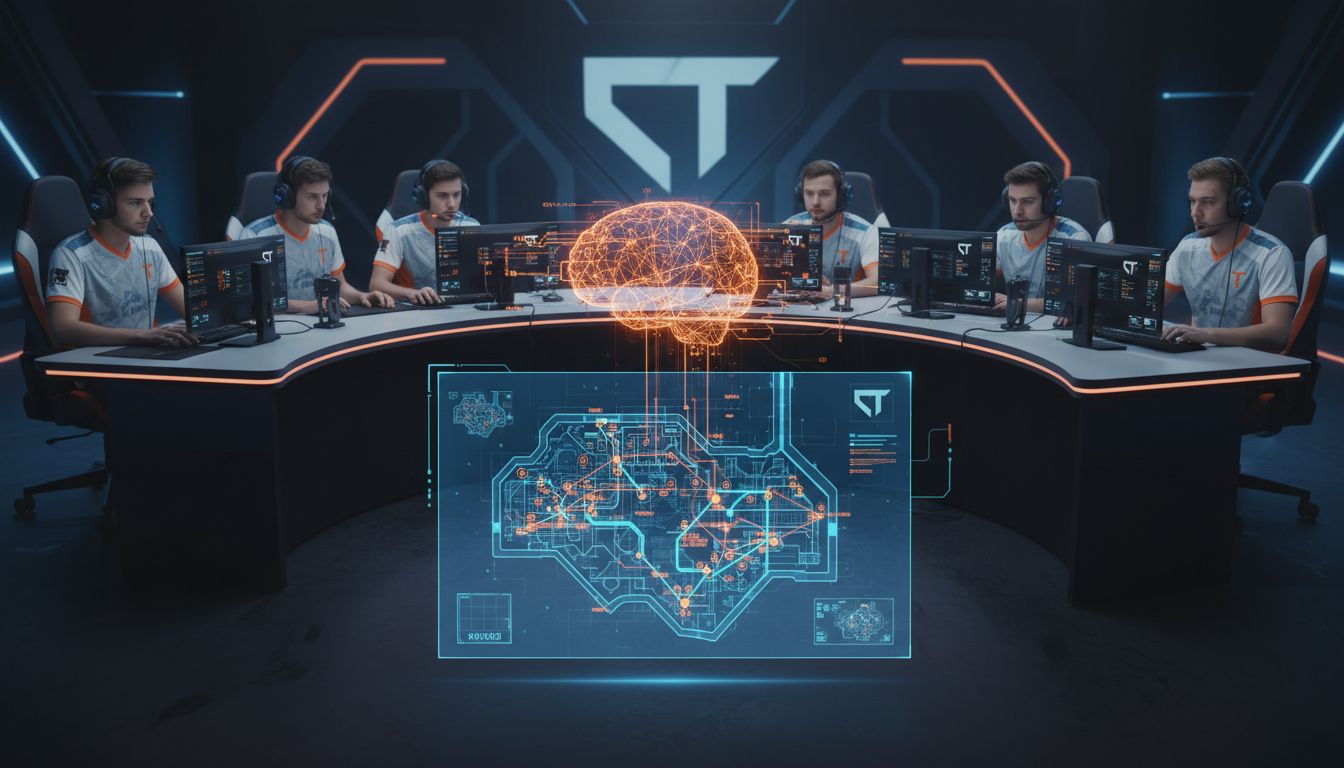
Teams no longer need to spend most of their preparation time hunting through full matches for one useful round, drive, possession, or tactical sequence. Machine learning models trained on pro replays are changing that workflow by turning recorded competition into searchable clips, tagged events, tendency reports, and faster prompts for coaching decisions.
For Counter-Strike players, coaches, analysts, and fans, the important point is not that a model can replace game knowledge. It cannot. The meaningful shift is that replay analysis can move from exhaustive manual review toward a process where software handles more of the tagging and sorting, while people spend more of their time judging opponent habits, testing counter-strats, and communicating a usable plan.
How machine learning models trained on pro replays change team preparation
Direct answer: Machine learning models trained on pro replays help teams prepare by identifying and labeling meaningful moments in video, organizing clips and statistics around coaching questions, and surfacing recurring tendencies faster than a fully manual film-review process. Coaches and analysts still need to validate the output and decide what matters, but they can spend less time finding footage and more time planning responses.
The traditional review problem is straightforward. A staff member watches footage, records events, makes clips, assigns labels, builds reports, and then tries to turn all of that work into a short briefing players can use. That process can be valuable, but it is labor-intensive and can make it hard to keep up when there are many matches, opponents, lineups, or practice sessions to review.
Replay-trained machine learning changes the first half of that chain. Rather than asking a human to locate every relevant sequence from scratch, a system can assist with detecting key moments, generating labels, grouping similar situations, and retrieving relevant video. The final aim is not a larger pile of data. It is a shorter path from “what happened?” to “what should we prepare for?”
The core operational shift is simple: AI increasingly handles the grunt work of tagging, clipping, and labeling footage, leaving coaches more time for tactical decisions.
There are already concrete examples across professional sports. AWS says that 75 machine learning models process NFL data in under a second for Next Gen Stats. Microsoft has described NFL clubs expanding AI work into player scouting and salary-cap management, while the NFL Players Association uses AI in video review to improve efficiency and player safety. These are not identical use cases, but together they show that machine-assisted analysis is moving beyond a novelty layer on top of broadcast footage.
For esports, Microsoft Garage’s Cloud9 Video Review Tool offers a particularly relevant model. It uses pre-trained machine learning models to identify key moments in esports matches, allowing coaches and players to review games faster. The principle maps cleanly to any replay-heavy competitive environment: if software can bring the most relevant moments to the front, the review session can focus on interpretation rather than endless navigation.
From replay footage to a practical opponent report
A useful preparation workflow needs more than automated highlights. Teams need a chain of evidence that connects footage to an actionable decision. In practice, that usually means combining the model’s output with an analyst’s context and a coach’s priorities.
- Collect relevant past matches. The input may include full game video, replay files, tracking data, play-by-play data, or several of these sources together.
- Detect and label events. A model can assist in identifying key moments and generating structured information from raw video.
- Group the evidence around a question. Instead of reviewing every clip, staff can investigate a defined theme: a recurring setup, a response after a specific trigger, a player tendency, or a pattern visible in self-scouting.
- Review the clips with context. A human checks whether the apparent pattern is meaningful, whether the sample is relevant, and what the opposition was trying to accomplish.
- Convert findings into training priorities. The final output should be concise enough to affect practice, pre-match briefings, and in-game communication.
This process explains why the phrase “trained on pro replays” matters. Replays and recorded match video are not useful merely because they are archived. They become operationally valuable when a model can learn to recognize or organize features within them, making footage easier to query and use.
What becomes faster
Hudl’s November 2025 film-study panel discussed AI helping with reports and film labeling, with one coach describing the possibility of AI acting “almost [as] an extension of the coach.” The panel also raised the idea of “video game style replay” and using AI to find tendencies that a team’s own self-scouting might miss.
That is a useful description of the time-saving opportunity. A staff member may know exactly what they want to investigate but lack the hours required to collect every example. Automated labeling and retrieval do not answer the tactical question by themselves. They reduce the time between asking the question and having enough relevant evidence to discuss it.
What remains a human job
- Determining whether a pattern is intentional, situational, or accidental.
- Accounting for opponent quality, score state, map or venue context, lineup changes, and strategic adaptation.
- Choosing which findings deserve practice time.
- Explaining a game plan in language that players can execute under pressure.
- Rejecting an output when the clips or labels do not represent what actually happened.
That division of labor is important for a Counter-Strike audience. A system might make a sequence easier to find, but it does not automatically understand whether a team’s early-round utility was a default, a one-off response, a bait for a later play, or a consequence of an earlier read. Tactical context remains the difference between information and preparation.
Faster film-to-decision cycles are the biggest competitive change
The most valuable effect of replay analytics is often speed, not prediction. Preparation has a deadline: the next practice, the next scrim block, the next match, or a live adjustment window. If a useful clip arrives after the coaching staff has already set the plan, its analytical quality matters less.
Microsoft’s 2025 account of the NFL Game Analytics Dashboard says analysts use Copilot-enabled tools to deliver data-backed insights before games and live strategic updates during games. Hudl has also highlighted live replay workflows intended to deliver instant insights during practice and games. Together, those examples point to a shrinking feedback loop between an event on the field and the staff’s ability to review it.
For a team, that can change the rhythm of preparation in several ways:
- Before competition: Staff can move more quickly from recent footage to a focused opponent package.
- During practice: Live or near-live replay workflows can make it easier to revisit a mistake while the drill, call, or tactical objective is still fresh.
- During competition: Where rules, staffing, and tools allow, analysts can provide faster evidence for strategic discussions.
- After competition: Faster labeling can help convert a match into a review agenda rather than leaving staff with a long queue of manual work.
Speed should not be confused with automatic accuracy. A rapid report can be less helpful than a carefully checked one if it overstates a weak pattern. But when the model is used to retrieve, sort, and prioritize footage rather than to make the final call, fast turnaround can improve the quality of the human discussion that follows.
AWS and SAP described this kind of operational improvement in a 2025 project with TSG Hoffenheim. Their AI-assisted video analysis and sharing workflow replaced hours of manual footage review and tagging, and the companies said it helps teams prepare more effectively for upcoming matches. The specific sport differs from Counter-Strike, but the preparation bottleneck is familiar: high volumes of video are useful only when the right people can turn them into a plan in time.
Scouting, self-scouting, and recruitment now draw on the same analysis stack
Opponent preparation is only one destination for replay-derived analysis. The same ability to structure past matches can support self-scouting, player evaluation, recruitment, and longer-term roster decisions. That matters because a team that stores video, events, and reports in disconnected places may struggle to learn consistently from its own history.
Holstein Kiel’s 2025 AWS case study describes an AI-powered scouting platform built with OpenAI models on Amazon Bedrock. The club used it to break down data silos and improve transfer decisions and team performance. In the NFL, Microsoft says clubs are expanding AI into player scouting and salary-cap management. The common theme is that model-driven workflows can help organizations connect information that would otherwise remain scattered among video, notes, data feeds, and staff.
Opponent scouting asks: what will they likely show?
This is the most recognizable use case. Teams search previous matches for tendencies, recurring responses, and situations that deserve a counter-plan. The output is often a concise report and a clip package designed around decisions players will face.
Self-scouting asks: what are we repeatedly revealing?
The Hudl panel’s discussion of AI identifying tendencies that self-scouting can miss is especially relevant here. Teams can become accustomed to their own defaults and assume they are varied enough, even when opponents can recognize repeated timing, positioning, or responses. Organizing a team’s own replay archive makes it easier to ask whether the same issue appears across multiple matches.
Recruitment asks: what evidence supports this evaluation?
Player evaluation is not the same as tactical preparation, but both depend on retrieving relevant evidence from past performance. A structured system can support a more repeatable review process by making video and supporting data easier to access. It does not eliminate the need for live scouting, expert judgment, or attention to role fit. It can, however, reduce friction when staff want to revisit what a prospect has actually done.
For Counter-Strike organizations, the strategic lesson is not that every team needs an enterprise platform. It is that the archive itself is an asset. Well-organized demos, VODs, notes, tags, and opponent reports make better questions possible. Machine learning can increase the value of that archive when it is deployed to make retrieval and review more practical.
Why replay-trained AI can make advanced preparation more accessible
Historically, intensive video work favored organizations with enough staff to watch, tag, clip, and summarize a large amount of footage. Machine-assisted workflows can make parts of that process more scalable. This does not mean every team gains the same advantage, or that strong analysts become unnecessary. It means the first-pass workload can be reduced.
AWS says ShotTracker’s AI-powered Scout product can answer coaching questions in near real time and return curated video and statistics in seconds. The company specifically says the product helps teams without full-time video analysts. That is a concrete illustration of how automation can extend analytical capacity rather than simply adding another dashboard for already large departments.
Operational cost is also part of the equation. Nielsen Sports reported a 75% cost reduction after modernizing a system that runs thousands of machine learning models for video analysis. Its work focused on video segmentation rather than direct coaching, so it should not be treated as a measure of coaching impact. Still, it demonstrates that ML-heavy video processing can become less expensive and easier to scale as systems are modernized.
What smaller teams can borrow without buying everything
The practical entry point is often workflow discipline, not a large AI investment. A community team, academy, or semi-pro Counter-Strike roster can use the same underlying logic even if it does not have automated computer vision or custom models.
- Define a small, repeatable tagging vocabulary for demos and VODs.
- Build reports around a few decisions that matter for the next opponent instead of collecting every possible statistic.
- Keep clips linked to specific claims so players can see the evidence quickly.
- Separate raw observations from tactical recommendations.
- Maintain a self-scout archive, not just opponent folders.
Those habits prepare a team to benefit from stronger tooling later. They also prevent a common failure mode: acquiring automation before anyone has agreed on what the review process is supposed to produce.
Limits of AI video analysis: models surface evidence, not certainty
The excitement around machine learning models trained on pro replays should not obscure their limits. Video can show that events occurred and models can help label or retrieve those events, but neither one automatically reveals intent. A tendency report can be misleading if it ignores context or if a team has already changed its approach.
Consider how quickly tactical environments change. An opponent may alter a lineup, revise its playbook, respond to a patch, or deliberately vary patterns after being scouted. In Counter-Strike, a single round can also be shaped by economy, spawn positions, a missed timing, a failed piece of utility, or an improvised read. A pattern that looks obvious in a clip collection may not be reliable enough to build a game plan around.
Three checks before acting on model output
- Check relevance. Is the footage recent enough, and does it involve a comparable opponent, lineup, role, or game state?
- Check completeness. Did the system retrieve enough examples to support the claim, including examples that do not fit the apparent tendency?
- Check actionability. Can the team explain a realistic response, rehearse it, and recognize when it applies?
Human review also matters because labels are only as useful as their definitions. If staff use inconsistent terms, or if the model’s categories do not match the team’s tactical language, the output can create confusion rather than clarity. The NFL and AWS example is instructive here: their ecosystem includes football-specific language in an AI chatbot and dashboards updated every three minutes. Tools become more useful when they fit the vocabulary and cadence of the people using them.
There are also practical governance questions. Teams need to understand what footage and data they are permitted to use, who can access internal reports, how player information is handled, and how much confidence to place in automated conclusions. The right standard is not “does the system produce an answer?” It is “can staff inspect the evidence and make a responsible decision from it?”
What this trend means for Counter-Strike coaching and analysis
The available examples come from football, basketball, tennis, general sports scouting, and esports, but the preparation pattern is highly relevant to Counter-Strike. CS already produces rich replay material: demos and match VODs preserve decisions, timings, utility, rotations, trades, setups, and adaptations. The challenge has always been organizing that material fast enough to improve the next match.
Microsoft Garage’s Cloud9 Video Review Tool demonstrates that pre-trained ML can help esports teams identify key moments for faster review. A 2026 ScienceDirect paper on automating sports scouting likewise describes AI and ML as ways to automate manual data gathering and support technical and tactical analysis for preparing against rivals. The paper notes that video-centered scouting workflows remain central, while AI can automate statistics generation from input video.
For a Counter-Strike coach, analyst, or serious team leader, the likely near-term value is not a magic system that calls every round correctly. It is a better review loop:
- Find comparable rounds or situations without manually scrubbing every map.
- Build targeted clip sets for a specific opponent question.
- Spot repeated self-scout issues across a longer match archive.
- Spend review time discussing responses, not locating timestamps.
- Return to practice with a smaller number of clearly supported priorities.
That last point matters most. Players do not need a twenty-page report immediately before a match. They need a small number of credible reads, recognizable triggers, and practiced responses. Replay-driven machine learning is valuable when it helps staff create that clarity, not when it increases the amount of information competing for attention.
Teams should also preserve the habits that make human analysis effective: watch the full context around decisive clips, compare assumptions with contrary examples, document why a read matters, and update the plan when new evidence appears. Automation can strengthen those habits by reducing manual workload. It cannot substitute for them.
A sensible way to adopt replay analytics without losing the coaching process
Teams considering AI-assisted replay analysis should start with one preparation bottleneck. It may be manual clipping, inconsistent tagging, slow self-scouting, or difficulty retrieving past examples during a short practice week. Starting with a defined problem makes it easier to judge whether a tool or workflow is actually helping.
- Name the decision you want to improve. For example, identify recurring opponent responses or review a repeated team mistake more quickly.
- Decide what evidence counts. Set expectations for the relevant footage, tags, context, and human verification.
- Test the output against manual review. Ask whether the system finds useful clips, misses important ones, or produces labels staff cannot trust.
- Build the result into a real meeting or practice routine. A report that never changes a drill, briefing, or decision is not yet delivering preparation value.
- Keep ownership with coaches and analysts. The team should be able to explain why it acted on a recommendation and revise it when the evidence changes.
This measured approach reflects what the strongest current examples actually show. NFL data pipelines, AI-assisted football video analysis, scouting platforms, live replay workflows, and esports video review tools are improving the speed and organization of analysis. They are not evidence that tactical expertise has become optional.
Machine learning models trained on pro replays are changing preparation because they shorten the distance between past performance and the next useful decision. Across sports and esports, the clearest gains are faster tagging, easier clip retrieval, more scalable review, and better access to evidence for scouting and self-scouting.
For the Counter-Strike community, the practical takeaway is to treat AI replay analysis as an assistant to a disciplined review process. Organize the footage, ask narrow tactical questions, verify the clips in context, and turn only the strongest findings into practice priorities. The teams that benefit most will not be the ones with the most automated output; they will be the ones that turn it into clearer preparation.