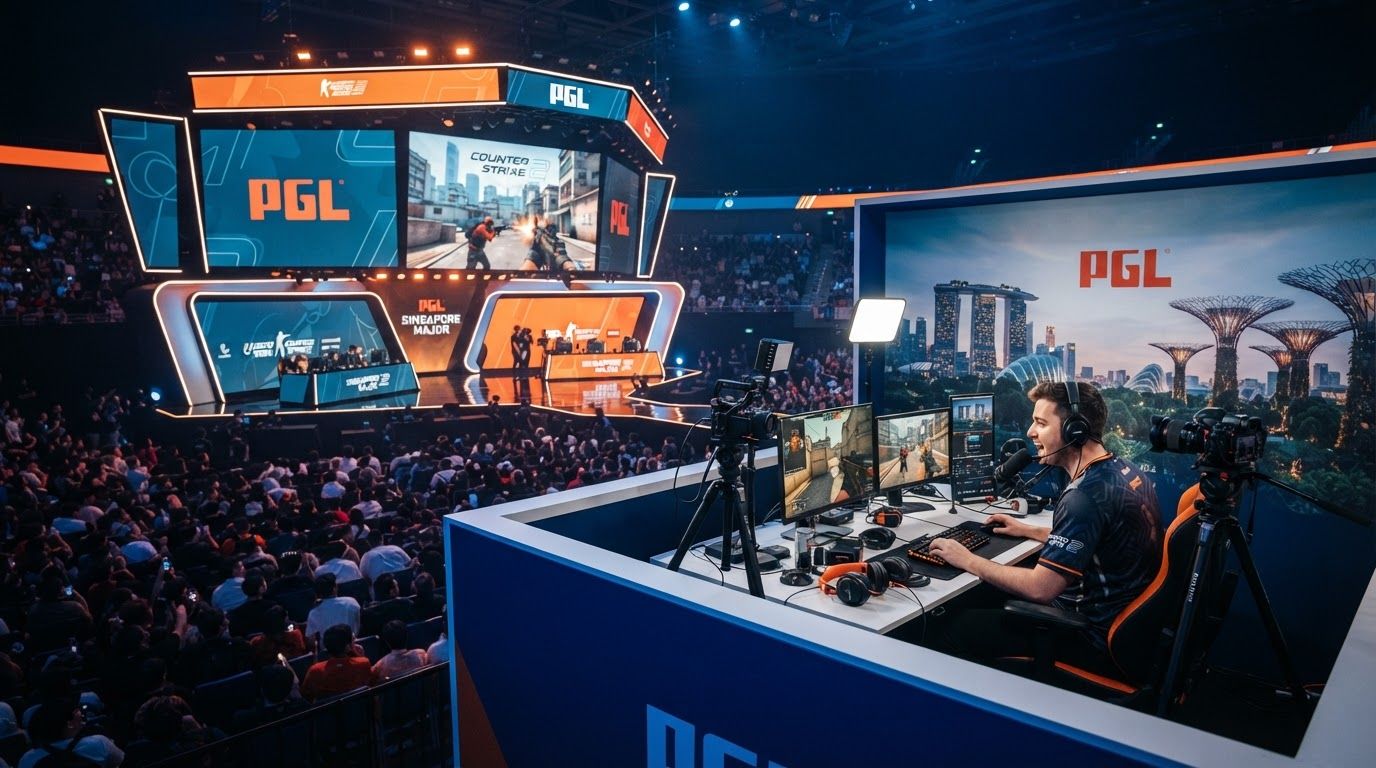
The PGL Singapore Major streaming rules change what community coverage can look like before a creator ever goes live. Fans can still watch creator-led coverage, but creators who want to cover the event need to separate a free, personal, non-commercial broadcast from a licensed commercial production.
That distinction matters for Counter-Strike communities because community streams often combine analysis, personality, sponsor support, and multiple guests. For the Singapore Major, scheduled for 24 November to 13 December 2026, PGL’s published guidelines put firmer boundaries around those elements while preserving a route for eligible individual creators to stream matches from the CSTV spectator feed.
What the PGL Singapore Major streaming rules mean in practice
Direct answer: PGL allows eligible independent individual creators to community-stream the Singapore Major for free from a personal, non-studio setting, using the in-game CSTV feed with its built-in 180-second delay. The free route is non-commercial: sponsor exposure and re-streaming official feeds are prohibited, while commercial or multi-talent coverage requires official licensing approval.
The policy is not a simple ban on community coverage. It creates two distinct paths: a narrowly defined free path for independent creators and a formal licensing path for coverage that is commercial, studio-based, organizational, or built around several on-air talents.
That is a meaningful change in the practical choices facing streamers. A creator may be able to broadcast the matches to their audience without paying for rights, but they cannot automatically treat that broadcast as a sponsor-supported show. A media company may have the staff and production capacity to offer polished coverage, but it cannot use the free creator route instead of obtaining media rights.
PGL’s stated rationale is protecting official broadcast partners and media-rights holders. Industry coverage from Esports Radar describes the approach as a strict non-commercial compliance framework and places it within a wider trend: major Counter-Strike tournament operators are seeking to preserve the commercial value attached to exclusive media rights.
The two routes are different businesses, not minor variations
- Free community broadcast: Intended for independent individual creators broadcasting from personal, non-studio environments under non-commercial restrictions.
- Licensed commercial coverage: Required for commercial co-streams and multi-talent co-streams, with creators or organizations expected to apply to PGL for approval.
Creators should not assume that being a familiar community voice, having a small audience, or covering only part of the tournament changes these categories. The relevant question is how the stream is produced and monetized, not simply whether the person behind it is a fan of Counter-Strike.
For viewers, the result may be a clearer distinction between official broadcasts, approved commercial productions, and personal watch-along-style coverage built around CSTV. The Major is still expected to attract concurrent viewership in the millions, according to iGB reporting, so PGL is applying these controls around one of the most visible Counter-Strike events of the year.
Who can use the free community-stream route
The free option is limited to independent individual creators. PGL says those creators must stream from personal, non-studio environments. Commercial media outlets, production houses, and digital content studios need a formal media-rights licence rather than relying on the free community-broadcast framework.
This is more specific than a rule saying “anyone may co-stream.” It means a channel’s operational setup can matter as much as its content. A creator streaming personally from a home setup sits within the model PGL describes. An outlet running a planned production with a studio, a production team, or an organizational brand may fall into the licensed category instead.
Why the personal, non-studio condition matters
Counter-Strike coverage can become professionalized quickly. A community broadcast may add a producer, remote guests, graphics, a dedicated editor, commercial partners, or an organization operating the channel. Each addition can change the character of the program from an individual stream into something closer to a media production.
PGL’s rules draw a line before that process becomes an informal replacement for a rights-holding broadcast. The free route allows fan-led access, but it does not grant a general right for companies to build a commercial event show around the Major without an agreement.
That does not make organized coverage impossible. PGL expressly leaves room for commercial or multi-talent co-streams through official licensing approval. The limitation is that creators and organizations must seek permission rather than assuming the free community rules cover them.
Questions a creator should answer before scheduling a broadcast
- Am I operating as an individual creator? The free route is for independent individuals, not commercial media outlets, production houses, or digital content studios.
- Is this a personal, non-studio broadcast? PGL identifies that environment as part of the free option’s eligibility.
- Will the stream have a commercial purpose or commercial presentation? If so, the licensing route is the relevant path to explore.
- Will several talents be presented as a co-stream? PGL says commercial or multi-talent co-streaming requires direct approval.
- Can I comply with every restriction around feeds, sponsors, and participants? Eligibility is not useful if the actual show format violates the rules.
These are planning questions, not a substitute for reading PGL’s current guidelines or contacting PGL about licensing. The organizer’s official news index lists the Singapore Major community broadcast guidelines, confirming that this is an active policy item rather than an informal interpretation from outside the event.
Why sponsor bans reshape creator economics at the Singapore Major
The most consequential restriction for many creators is the ban on sponsor exposure. Reporting on the guidelines says community streams cannot use brand overlays, channel panels, on-stream product placements, or chat promotions. Those limits remove several of the familiar ways a creator might finance event-day coverage.
For a normal stream, a sponsor relationship can appear across the screen, in the channel’s panels, in a host-read integration, or in messages promoted to chat. Under PGL’s non-commercial framework for the Singapore Major, those placements are not available on the community stream. The issue is therefore not merely whether a sponsor logo is visible during gameplay; it is the broader commercial treatment of the broadcast.
What is restricted on the community broadcast
- Brand overlays on the stream.
- Branding in channel panels.
- On-stream product placements.
- Chat promotions.
Third-party coverage has described the sponsor restrictions as one of the clearest shifts from previous Major-era community-stream practices. That assessment makes sense from a creator perspective: a broadcast can remain technically possible while becoming harder to justify financially, especially if the creator normally allocates sponsor deliverables to major tournament streams.
There is a trade-off rather than a single outcome. A creator can retain a community-facing role by following the free path, potentially keeping their audience together around a large event. But they may need to treat the show as non-commercial programming instead of a revenue-generating campaign. That can influence how many hours they stream, how much production effort they add, and whether they bring in additional talent.
The sensible alternative for a sponsored production
If a creator, team, outlet, or studio wants a commercial format, PGL says to apply directly for official licensing approval. That is the route for a sponsored co-stream or a multi-talent production rather than attempting to fit commercial elements inside the free framework.
Approval is not described as automatic in the provided guidance, and the terms of any licence are not set out here. Creators should therefore avoid promising partners a Singapore Major activation before they have the necessary approval and understand the permitted format. A sponsorship agreement that depends on overlays, product placements, or chat promotion is poorly matched to a free non-commercial community broadcast.
For fans, fewer branded community streams could make personal coverage feel more like a straightforward shared viewing experience. For creators, it puts greater value on audience trust, match knowledge, entertaining commentary, and post-match discussion that does not rely on prohibited sponsor presentation during the event stream.
Use CSTV, not an official event feed
PGL requires community broadcasts to use the in-game CSTV spectator feed. That feed carries a built-in 180-second delay. Re-streaming any official event feed is prohibited, including official livestreams that may be available inside the game client.
This is one of the clearest operational rules in the policy. A creator cannot simply take the polished official broadcast, add a webcam or commentary, and send it to another platform. Nor can the availability of an official feed in the Counter-Strike client be treated as permission to retransmit it.
Why feed choice changes the viewing experience
The official show and the CSTV spectator feed serve different purposes. An official broadcast is the event’s produced media product, with its own presentation and rights value. CSTV is the designated source for qualifying community coverage under PGL’s rules, and its 180-second delay is already part of that approved viewing path.
That delay affects how a creator should manage expectations. A community audience watching CSTV will not be seeing the action at the same moment as viewers on a live official broadcast. Social posts, results notifications, and conversations in other communities may reveal outcomes before the delayed stream reaches a key round.
Creators cannot eliminate the required delay, but they can make their own coverage more usable within it. They can remind viewers that the stream follows CSTV timing, discourage spoilers in their communities where practical, and focus commentary on the round currently being shown rather than on outside reactions. These are audience-management choices, not workarounds to the delay.
A compliant feed workflow
- Open and use the in-game CSTV spectator feed required by PGL.
- Keep the feed’s built-in 180-second delay intact.
- Build commentary and visual presentation around that source rather than an official livestream.
- Do not capture or retransmit official event broadcasts, including official feeds accessible in the game client.
- Review the finished scene and source setup before going live so an official feed has not been added by mistake.
The last step is particularly important for creators who use reusable streaming scenes. A scene created for another tournament, platform, or watch party may contain browser sources, capture sources, panels, or branded material that does not fit the Singapore Major community rules. Checking the actual live setup is more reliable than assuming an old template is safe.
Guest appearances and Valve competitive bans
PGL’s guidelines also control who may appear on a community stream. Anyone currently serving a Valve competitive ban is barred from appearing in any capacity, including by video or voice.
The phrase “in any capacity” is broader than a ban on putting a person on camera as a featured analyst. It covers audio participation as well. A creator should not treat a voice-only guest, a short remote call, or an off-camera contribution as outside the restriction.
Plan the guest list before the first match
Community streams often become collaborative on short notice. A friend joins Discord, a former player calls in for one map, or a co-host appears after a long day of matches. Under this rule, improvising without checking eligibility creates an avoidable compliance risk.
A practical production plan should identify every expected contributor: hosts, commentators, analysts, remote guests, and people who may speak on stream. If an individual is currently serving a Valve competitive ban, they cannot be part of the community broadcast by voice or video.
This rule also reinforces the value of keeping roles clear. A solo creator who fits the free path may still invite permitted guests where the overall format remains compliant, but a multi-talent production may require official licensing approval. The participant rule and the licensing rule address different issues, so satisfying one does not automatically satisfy the other.
- Check planned on-camera and voice contributors before announcing them.
- Avoid casual call-ins from people whose eligibility has not been verified.
- Keep a backup plan for commentary if a scheduled guest cannot participate.
- Remember that a qualifying guest does not by itself make a commercial or multi-talent format eligible for the free route.
For viewers, this may mean some familiar community personalities are absent from Singapore Major streams. The rule is nonetheless straightforward: current Valve competitive bans exclude appearances in both video and voice, and streamers need to account for that before their broadcast begins.
How the rules affect coverage choices for creators and fans
The new framework is likely to produce a more segmented coverage ecosystem. Official rights holders can protect the value of their broadcasts. Individual creators can still add personality and community discussion through a free CSTV-based route. Commercial operators have a channel to pursue approval, but they cannot assume that community-stream status replaces a media-rights licence.
That segmentation changes what audiences should expect from each type of stream. A personal creator broadcast may emphasize live reactions, tactical observations, viewer discussion, and a familiar host. An official broadcast is more likely to remain the place for the organizer’s fully produced event presentation. A licensed commercial co-stream, if approved, could occupy another space, but its availability and terms depend on PGL approval.
What creators gain and give up
The free path provides access. It lets eligible independent creators cover a Major without the policy requiring them to begin with a commercial media-rights deal. For smaller communities and language-specific audiences, that access can be meaningful: a trusted creator can follow the tournament with viewers using the allowed feed.
In exchange, creators give up significant freedom around monetization and production. They cannot use the sponsor exposure listed in the rules, cannot restream official feeds, must accept CSTV’s 180-second delay, and cannot include people currently serving Valve competitive bans. Creators who want a bigger produced show must move from assumed permission to an approval process.
What fans may notice
Fans may find that creator streams are less visually commercial than they are during other events. They may also see fewer highly produced unofficial broadcasts because studio-style or organizational productions need licensing. At the same time, the remaining personal streams may be more clearly centered on the creator’s analysis and their audience’s conversation.
The delay is the most immediate viewing difference. A fan switching between an official live broadcast, social media, and a CSTV community stream may encounter spoilers. Viewers who prefer a particular creator should decide whether that community experience is worth following on delayed timing, while viewers who prioritize immediacy may prefer the official coverage route.
Neither choice is inherently better. The rules make the distinction more visible. A fan can support an independent community voice while recognizing that the stream is not meant to duplicate the official product, and a creator can choose the free route without presenting it as a substitute for commercially licensed coverage.
Singapore’s wider compliance environment adds context
The streaming policy is not the only way compliance issues are shaping the Singapore Major’s presentation. Separate reporting says Singapore’s gambling-advertising rules have required several teams, including BC.GAME, 1win, BETBOOM, and PARIVISION, to rebrand for the tournament.
That team rebranding is distinct from PGL’s community-broadcast rules, so the two should not be confused. One concerns local gambling-advertising restrictions affecting how teams present themselves at the event. The other sets PGL’s conditions for creator coverage and protects media-rights value. Together, though, they show that the event is being presented within a tighter compliance environment than a fan may notice from the server alone.
Why this matters to Counter-Strike communities
Counter-Strike fans are used to tournament coverage crossing many channels: team accounts, broadcaster desks, creator streams, sponsor campaigns, clips, and in-game viewing options. The Singapore Major demonstrates that those channels do not all operate under the same rules. Local regulation can affect team branding, while organizer policy can control community broadcast feeds, monetization, and participation.
For creators, the lesson is to treat event coverage as a rights and compliance question as well as a content question. A strong match-day plan needs more than good analysis, a working CSTV setup, and a social post. It also needs a clear understanding of which elements are permitted under the specific event policy.
For community members, the useful response is not to assume that a missing sponsor, altered team branding, or absent personality reflects a lack of interest in the Major. In many cases, the visible changes may be the result of rules shaping how the event can be shown and marketed in Singapore.
Preparing for compliant Singapore Major community coverage
Creators who intend to cover the event can reduce uncertainty by deciding their format early. The key decision is whether the stream is genuinely an eligible personal, non-commercial broadcast or whether its commercial and production ambitions make a licensing application the appropriate route.
Trying to blur that line is risky for both the creator and the audience. It can lead to last-minute changes, disappointed sponsors, guest cancellations, or a stream format that no longer resembles what viewers were promised. A clear choice at the planning stage produces a cleaner experience.
Checklist for the free community path
- Confirm that the channel is operated by an independent individual creator from a personal, non-studio environment.
- Use the in-game CSTV spectator feed and preserve its built-in 180-second delay.
- Do not re-stream official event feeds, including official livestreams available through the game client.
- Remove sponsor overlays, channel panels, product placements, and chat promotions from the community broadcast.
- Ensure no person currently serving a Valve competitive ban appears through video or voice.
- Review the rules again close to broadcast time and use PGL’s official guidance as the controlling reference.
When to seek official licensing approval
Contact PGL about official licensing if the planned show is commercial or multi-talent. That includes situations where the project is designed as a sponsor-supported production, is run by a media outlet or studio, or is intended to operate beyond the individual personal-stream model described in the free guidelines.
The important limitation is that the provided policy information confirms the approval route exists but does not promise that every application will be accepted or define every possible licence term. Build plans around confirmed permission, not assumptions. This is especially important for organizations arranging talent, graphics, promotional commitments, and sponsor deliverables in advance.
The Singapore Major’s community-stream system still leaves room for creators to bring their own perspective to Counter-Strike’s biggest stage. Its central message is simply more structured than in a loose co-stream environment: use CSTV, keep the free broadcast non-commercial, respect participant restrictions, and seek approval when the coverage becomes a commercial or multi-talent production.
For fans, the practical takeaway is to expect a mix of official broadcasts and more personal CSTV-based creator coverage during the 24 November to 13 December 2026 event. For creators, the best preparation is to choose the right path early, configure the stream around the permitted feed, and let PGL’s published guidelines,not past Major habits,set the boundaries for Singapore Major coverage.