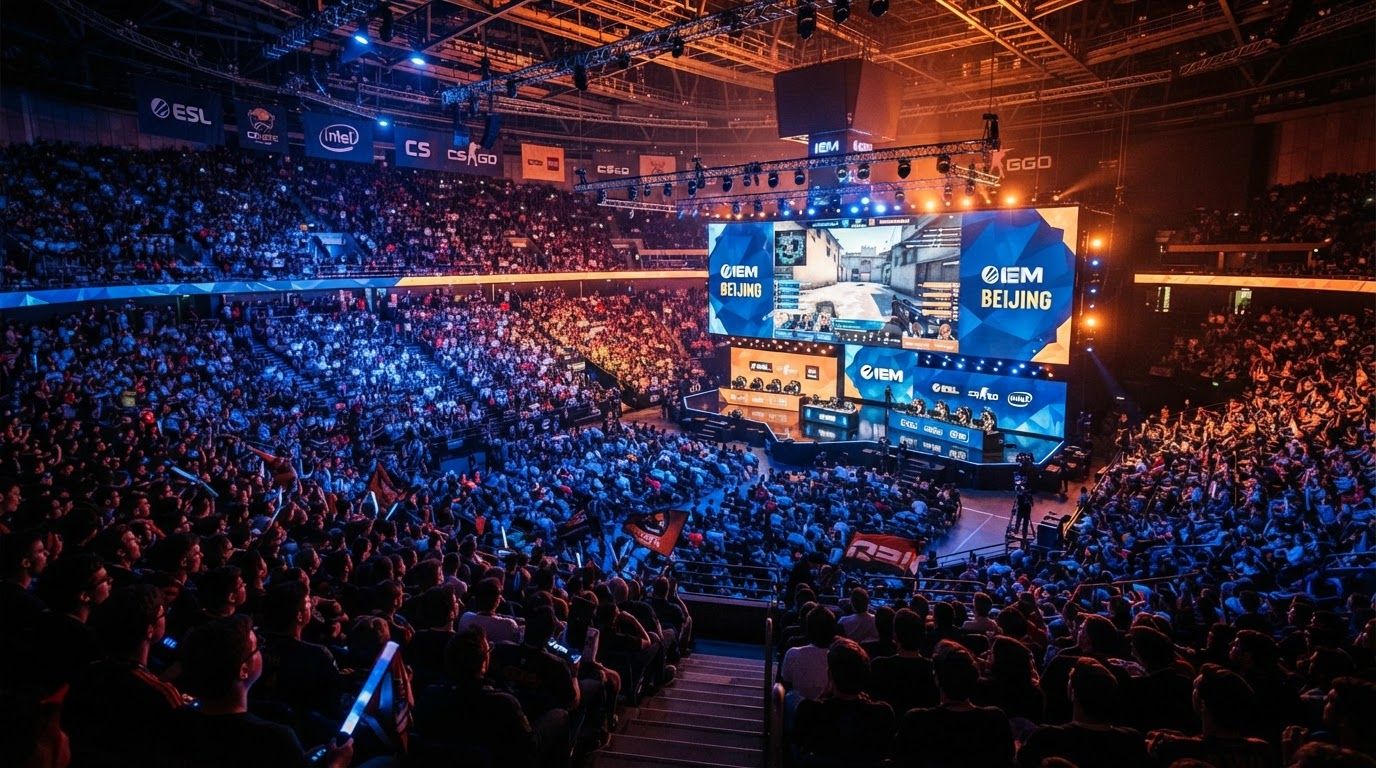
Packed venues can make Counter-Strike feel bigger on stream, but they also raise the operational cost of getting teams ready to play. At IEM Beijing 2026, the IEM Beijing arena strategy is pairing a larger, fan-first production with a calendar that leaves some teams managing compressed practice, jet lag, and difficult event choices.
This is not simply a question of louder crowds. ESL expects more than 45,000 attendees across all six tournament days and says Beijing will be the largest standalone IEM event in Asia to date. That scale changes what viewers see on broadcast, what sponsors can activate on site, and how teams must plan their travel, preparation, and tournament priorities.
How the IEM Beijing arena strategy changes the televised product
The most visible change is the 360-degree stage. ESL says the design is intended to deliver a more immersive experience for players and fans, while HLTV reported that main broadcast matches are being played in front of a crowd on that 360-degree stage. In practical terms, the arena is no longer just a backdrop for the final weekend: it is part of the broadcast’s central visual and emotional language.
A conventional esports broadcast can rely heavily on the game feed, player cameras, desk analysis, and occasional audience shots. A packed, all-around arena gives production more ways to establish scale and react to decisive moments. Crowd images, stage-wide angles, player walkouts, reactions after clutches, and the visible density of the venue can all support the story of a close series without replacing the match itself.
Atmosphere becomes a broadcast asset
HLTV’s event coverage described close maps as high entertainment for both people in the venue and people watching at home. Its day-one reporting also said the arena crowd amplified the drama of Mirage and that the broadcast translated that energy to remote viewers. That connection matters because home viewers do not need to be physically present to understand that a round has consequences.
For producers, a lively crowd can sharpen the contrast between routine rounds and pivotal ones. The in-game action remains the foundation, but a sudden rise in audience reaction can signal a clutch, a comeback, or a momentum swing before the scoreboard fully explains it. This makes the broadcast feel more communal, especially for fans watching with friends or following the event through community discussion.
Direct answer: Packed arenas at IEM Beijing are pushing broadcasts toward 360-degree visual coverage, crowd-led match storytelling, and deeper sponsor and fan-activity integrations. At the same time, the event’s place in a busy international calendar is forcing teams to prepare earlier, refine less on site, and make harder travel decisions.
There is an important limit to this approach. A charged arena cannot turn an uncompetitive match into a classic, and broadcast spectacle cannot compensate for unclear analysis or weak game coverage. The value of the crowd is that it adds context to strong Counter-Strike, particularly when maps are close and every round changes the emotional temperature of the room.
Why a six-day live audience matters for Counter-Strike event coverage
ESL has said that fans will be welcomed throughout all six tournament days. That is a meaningful design choice because it treats early competition as part of the live product rather than saving the complete arena experience only for the latest stages. ESL has also positioned Beijing as a direct evolution of IEM Chengdu 2025, where the group stage had a live audience.
That continuity suggests the live-audience group stage is becoming a core element of the IEM China formula rather than a one-off experiment. For viewers, it can make the tournament feel consequential from the first day. For teams, it means more matches are played under visible public pressure, with all the crowd noise, attention, and production focus that come with a major arena setting.
- Early matches gain presentation value: A live audience makes group-stage games feel like event programming, not merely a lead-in to the playoffs.
- Coverage can sustain momentum across the week: Production has crowd, stage, and venue stories available before the final days.
- Players face the public environment sooner: Teams cannot assume that only late-round matches will carry a full live-event atmosphere.
- Fans have more ways to participate: Attending on more competition days broadens access beyond a narrow final-weekend window.
For a community that follows match results, roster form, and tactical trends closely, the wider live window also changes the rhythm of discussion. A group-stage result in front of a crowd may receive more immediate attention because the setting makes the game easier to package into clips, post-match analysis, and conversations about pressure, confidence, or momentum. Those reactions should not be mistaken for proof that crowd conditions alone determine results, but they are part of the way modern event narratives develop.
The trade-off: bigger moments, more production pressure
Building around a packed arena asks more of the event operation. The production must consistently capture the room without obstructing the match, keep the 360-degree stage legible for both in-person and remote audiences, and make sponsor elements feel connected to the show rather than detached from it. The larger the visual promise, the more noticeable any mismatch becomes between the arena energy and the broadcast’s pacing.
For fans at home, the best outcome is straightforward: the venue makes the game easier to feel, while the broadcast still makes the game easy to follow. Counter-Strike viewers need clean information on economy, utility, positioning, and round flow. Arena coverage works best when it enhances those essentials instead of competing with them.
Broadcast strategy now extends to sponsor segments and fan activations
IEM Beijing’s approach is not limited to cameras pointed at a large audience. ESL has described a “next level” production that includes fan activations, partner activations, signing sessions, and on-site activities across the competition days. Logitech G’s expanded partnership includes direct broadcast segment integrations as well as immersive live fan experiences.
That pairing shows why packed arenas are commercially significant. The same event environment can host a signing session for attendees, create a visible branded activity on site, and provide a natural transition for a broadcast segment. Rather than treating sponsorship as something outside the match show, the Beijing model places partners closer to the event experience viewers and attendees share.
What a tighter integration can accomplish
- Give sponsors a clearer role in the show. Direct broadcast segment integrations put a partner inside an identifiable piece of programming rather than relying only on static exposure.
- Link the arena and the stream. An immersive fan experience can create material for the venue while also giving remote viewers a sense of what is happening beyond the server.
- Fill the space between matches. Activities, signing sessions, and partner activations offer programming touchpoints during a long multi-day event.
- Strengthen the event identity. When stage design, crowd participation, and partner activity align, the tournament can feel like a single experience instead of a series of isolated matches.
There is a balance to protect. Counter-Strike fans generally come first for the competition, and sponsors benefit most when their involvement supports that reason for watching. The useful test is whether an integration adds to the viewer’s understanding, anticipation, or enjoyment of the event. If it interrupts a key tactical discussion or draws attention away from a live competitive moment, the same visibility can become counterproductive.
The Beijing setup offers a different answer from a standard arena event because the fan program is spread across the competition days. This gives broadcast planners more options than simply inserting promotions around a final-stage crowd. It also gives partners a stronger reason to invest in the full event journey, from early matches through the most watched series.
Team travel planning is becoming part of IEM Beijing preparation
The fan-facing gains come with a clear competitive constraint: teams still have to arrive, recover, practice, and play. HLTV quoted Aurora AWPer woxic saying that the team had to prepare strategies before matches and then use them immediately in officials because the travel schedule left little time to refine details. His assessment was blunt: “This travel schedule isn’t good for us, or for anyone.”
This does not mean every team experiences the trip in the same way. Rosters have different prior events, travel routes, support structures, and competitive goals. But it does show why travel should be understood as part of preparation rather than a logistical detail that begins after the tactical work is finished.
What compressed preparation looks like
Normally, strategic preparation includes identifying opponents’ tendencies, selecting map-specific approaches, rehearsing executes or defensive adjustments, reviewing mistakes, and refining details after practice. When a team must prepare an idea before travel and use it quickly in an official, the cycle becomes shorter. There is less room to test a concept, discard it, and rebuild it before the next match.
Aurora coach ash also said the busy schedule makes it difficult to correct mistakes between events. That is particularly relevant in Counter-Strike, where small communication errors, utility timing issues, and positional misunderstandings can require focused review to solve. A crowded calendar does not eliminate the need for those corrections; it reduces the available window for making them properly.
- Pre-event scouting becomes more important because some plans may need to be set before the team reaches Beijing.
- Teams may need to prioritize a smaller number of high-confidence ideas over a wider pool of untested variations.
- Review sessions must compete with recovery, media obligations, travel, and immediate match preparation.
- Coaches and analysts face a harder choice between fixing the last series and preparing for the next opponent.
For viewers, this context can improve post-match analysis. A tactical miss should not automatically be reduced to a travel excuse, and a strong performance on a difficult schedule deserves more than a vague label of momentum. The more useful lens is to ask what a team had realistic time to prepare, how recently it travelled, and whether its performance suggests problems in execution, adaptation, or physical readiness.
Jet lag and recovery can shape performance before the server opens
Travel strain is not only about strategy. MOUZ player xertioN said the team was battling jet lag and that “It’s not easy to travel and play the day after.” The point is simple but significant: international Counter-Strike asks players to perform cognitively demanding work under conditions that can disrupt normal recovery and routines.
Players need to make quick decisions, communicate precisely, track economy, respond to utility, and adapt to opponents in real time. The event reporting does not establish a measurable effect on every individual or match, so it would be wrong to assign a result to jet lag alone. It does establish that players themselves are identifying the strain as a real part of the tournament experience.
What teams can control, and what they cannot
Teams can plan some elements in advance: arrive with prepared material, account for the next event when building a calendar, and protect practice time where the schedule allows. They cannot fully remove the demands of a long international circuit, especially when events and ranking opportunities overlap. The decision is therefore about managing trade-offs, not finding a perfect itinerary.
Beijing’s audience scale makes that trade-off sharper. A major live event offers exposure, elite opposition, audience energy, and competitive significance. Yet those benefits arrive alongside the physical cost of travel and the possibility that limited recovery affects the quality of preparation. For organizations, a successful season plan has to value both the opportunity of the event and the condition in which the roster reaches it.
ESL’s 2026 qualifier policy provides useful context here. The policy aimed to reduce travel fatigue by using European servers for global qualifiers, indicating that travel load has become a formal competition-design concern around IEM-level events. Server policy cannot solve the travel demands of a global LAN calendar, but it recognizes that unnecessary movement before a major event can affect competitive readiness.
IEM Beijing can force roster and calendar decisions beyond the event
The impact of Beijing reaches outside its own match schedule. HLTV reported that TYLOO withdrew from HyperX Retake because of a scheduling conflict with IEM Beijing. This is a concrete example of how a major arena tournament can influence where a team plays, which opportunities it gives up, and how it allocates its players and staff.
TYLOO coach zhokiNg said the team had to consider the Beijing conflict in advance and prepare for both scenarios. That is the kind of planning pressure that fans often see only after an announcement is made. Behind a withdrawal or a roster decision may sit questions about qualification paths, ranking points, travel timing, practice quality, and the risk of splitting attention across overlapping obligations.
Why accepting or declining an invite is not a simple signal
HLTV’s invite report showed that Vitality and Spirit declined invites to Beijing, while teams including FURIA, Liquid, The MongolZ, FaZe, and others accepted the trip. The mixed field confirms two things at once. Beijing remains attractive enough to draw a globally varied set of teams, and even a major event does not override every organization’s travel-management priorities.
It would be a mistake to treat a declined invite as a judgement on the venue or the event’s importance. A team may be weighing its existing calendar, recovery needs, qualification goals, and broader season plan. Likewise, acceptance does not mean the trip is effortless; it means the organization has decided the competitive and commercial opportunity is worth the associated demands.
- Check conflicts early. Teams need to identify overlap with other tournaments before commitments become difficult to change.
- Map the preparation window. The key question is not only when a match starts, but when the roster can realistically practice, review, and recover.
- Assess the opportunity cost. Choosing Beijing can affect another event, as TYLOO’s HyperX Retake withdrawal illustrates.
- Align the choice with season goals. Ranking points, qualification routes, player condition, and opponent quality all belong in the same decision.
This is where community discussion can become more accurate. Rather than assuming that every top team should attend every major arena event, fans can recognize that global Counter-Strike has logistical limits. A healthy competitive circuit needs exceptional live moments, but it also needs teams capable of arriving prepared enough to make those moments meaningful.
What fans should watch for in Beijing’s crowd-led broadcast
For fans watching the stream, the value of the arena strategy will be most apparent in how production uses the room around the game. HLTV’s reporting already points to crowd energy being carried from the venue to the home audience. The strongest broadcasts will make that energy readable without losing the tactical clarity that Counter-Strike audiences expect.
Signals of a well-balanced arena broadcast
- Purposeful crowd shots: Reactions should help frame a pivotal round, comeback, or map-ending moment.
- Clear 360-degree staging: Wide visuals should communicate the scale and immersion of the venue without making players or match action feel distant.
- Useful sponsor integrations: Direct segments work best when they fit naturally around analysis, transitions, or fan experiences.
- Visible fan activity beyond the seats: Signing sessions and activations can show why the six-day event is more than a sequence of games.
- Respect for the match: The broadcast should return quickly to the server, the desk, and the strategic story whenever competition demands it.
For those attending, the 360-degree format and all-week fan program should create a different relationship with the tournament than a finals-only arena. For those at home, the question is whether those in-person advantages are successfully translated into a better viewing experience. The evidence from HLTV’s early coverage suggests that close maps can benefit from the added atmosphere, particularly when the crowd’s response gives the action an immediate sense of scale.
For teams, the broadcast spotlight is another reason preparation matters. A packed arena magnifies memorable plays, but it can also magnify visible miscommunications or unprepared tactical choices. That pressure is part of top-level competition; the concern raised by Aurora and MOUZ is that the travel calendar can make meeting that standard harder than the audience sees.
The long-term lesson for Counter-Strike event planning
IEM Beijing shows that event design and competitive scheduling can no longer be treated as separate conversations. ESL’s move from Chengdu 2025’s live-audience group stage to a six-day Beijing audience, with an expected total of more than 45,000 attendees and a 360-degree stage, demonstrates a clear push toward more immersive live Counter-Strike. Sponsor integrations and fan activities extend that push beyond the match itself.
At the same time, player and coach comments, a qualifier policy aimed at reducing travel fatigue, and the choices surrounding invites and event conflicts show the other side of the equation. The biggest arena model is sustainable only when organizers, teams, and partners take the logistics seriously enough to protect competitive quality. A loud venue is valuable because it captures great Counter-Strike, not because it removes the need to create the conditions for it.
The key takeaway is that packed arenas are changing both sides of IEM Beijing. Fans and remote viewers gain a more theatrical, crowd-driven broadcast, while teams must make earlier and more disciplined decisions about strategy, recovery, and the events they can realistically play. As IEM China continues to build on the live-audience approach, the most important measure will be whether the spectacle and the competitive environment keep improving together.
For Counter-Strike fans, watch the server and the schedule at the same time. The 360-degree stage, sponsor segments, and crowd reactions explain how Beijing is being presented; player comments, invite decisions, and calendar conflicts explain the preparation burden behind that presentation. Seeing both sides gives a more complete picture of what a modern global arena event demands.