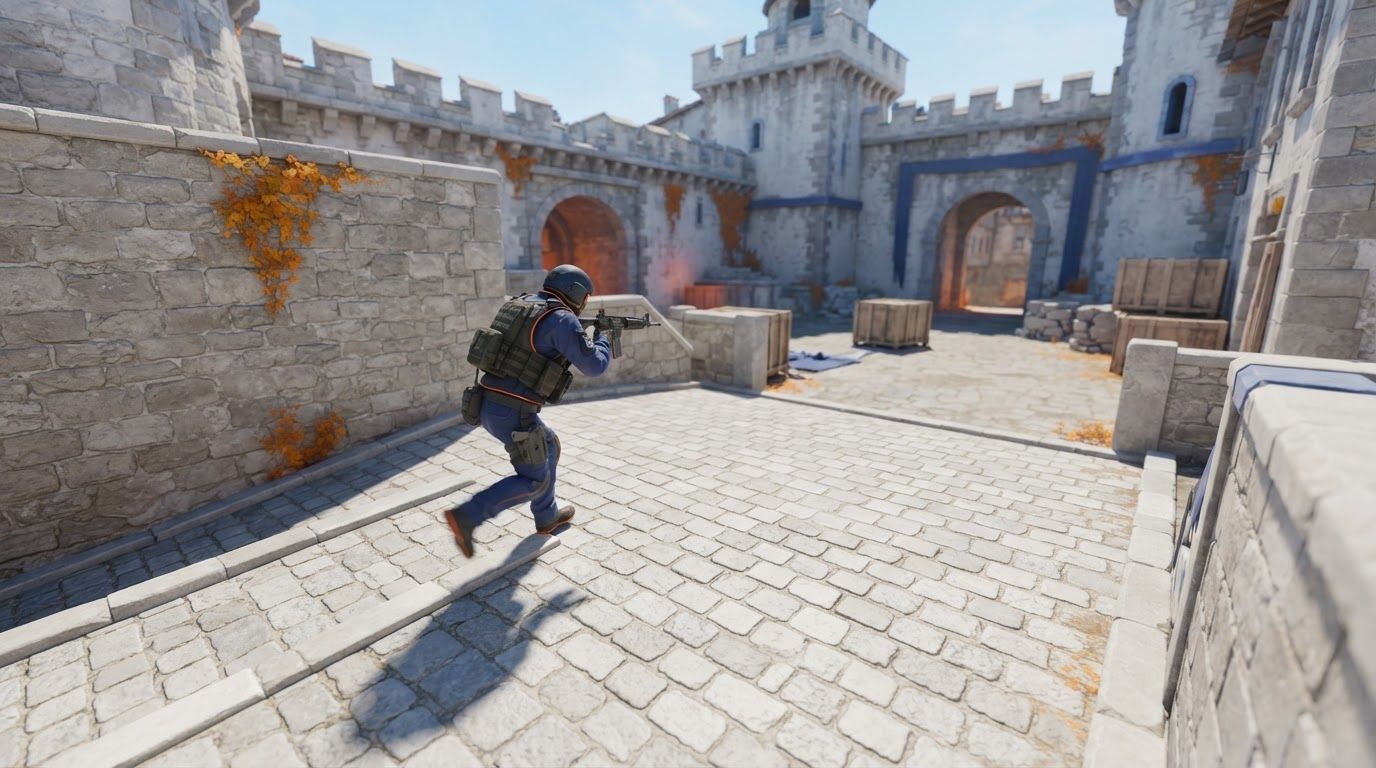
Fresh Cobblestone fixes address the kinds of map problems that can make a round feel unreliable: awkward movement, unintended ledges, geometry gaps, and spots where grenades or the bomb can become inaccessible. For players returning to the map in Counter-Strike 2, the important takeaway is that Valve has moved quickly to clean up issues discovered after Cobblestone re-entered official matchmaking.
Cobblestone returned on November 17, 2026 with familiar areas such as drop, chicken coop, and stables, alongside changed routes and snowy traversal. Updates on November 18 and November 23 then focused heavily on collision, map boundaries, and exploit-prone locations, so teams should revisit the map with an eye on how their movement, utility, and post-plant habits now work.
Cobblestone fixes smooth movement and close hidden map gaps
The November 23 CS2 patch explicitly included fixes for smoother player movement throughout Cobblestone. It also fixed some bad boosts and walkable ledges, a B-site location where grenades could fall through the world, and various gaps in the world.
That combination matters because these are not purely visual changes. Collision and geometry affect how consistently players can take space, escape pressure, line up utility, and carry the objective through a round. A route that feels uneven or catches movement unexpectedly can change timing; a gap that swallows a grenade can remove a critical defensive or attacking tool.
Direct answer: The latest Cobblestone fixes target smoother traversal, unintended boosts and ledges, world gaps, a B-site grenade-loss spot, princess tower bomb access, and selected wall-bang locations. Players should recheck familiar routes and utility setups because the map received two cleanup updates within five days of returning to official matchmaking.
The patch notes do not provide a complete technical breakdown of every corrected surface or gap. It is therefore best not to assume that every unusual jump, edge, lineup, or angle on the map has changed. The practical conclusion is narrower: locations tied to the listed issues deserve a fresh test before they are relied on in a competitive match.
Why the November 23 Cobblestone update matters in real matches
On November 23, Valve addressed several distinct categories of Cobblestone problems in the same update. Looking at them together helps explain why this was more than a cosmetic map pass.
- Smoother player movement throughout the level: This targets traversal friction and awkward movement across the map rather than a single named position.
- Bad boosts and walkable ledges: These fixes reduce access to unintended positions that could create confusing sightlines or unfair elevation advantages.
- A B location where grenades could fall through the world: Utility that disappears into geometry is unreliable utility, especially when a smoke, flashbang, or incendiary is needed at a decisive moment.
- Various gaps in the world: World gaps can create visual, collision, or object-handling problems, depending on the exact location.
- Princess tower bomb access: Valve fixed a spot where the bomb could be thrown out of reach, removing a round-disrupting objective exploit.
- Bad wall-bang locations: The update also corrected some locations where penetration behavior was considered problematic.
For competitive players, the princess tower change is especially easy to understand. When the bomb can be thrown somewhere no can retrieve it, a normal objective contest can become an unintended dead end. Fixing that spot helps keep the round centered on recoverable decisions: protecting the bomb, recovering it, defending it, or denying it.
The grenade issue at B has a similar competitive impact, even though it involves a different game system. Players often build executes and retakes around precise utility timing. If a grenade enters a map gap rather than behaving as expected, the result is not simply a missed throw; it can break the sequence that teammates expected to follow.
What changed in the first Cobblestone cleanup pass on November 18
The November 23 changes followed an earlier Cobblestone repair pass only a few days after the map’s return. On November 18, Valve fixed some walkable ledges in long A, an empty skybox, an audio blocker issue by mid/A, a grenade clip on the assault van bumper, and various gaps in the world.
This earlier update is useful context because it shows where initial post-return testing found problems. The listed fixes cover movement, visibility, audio behavior, grenade collision, and map boundaries rather than one isolated area.
Long A ledges and unintended traversal
Walkable ledges in long A were specifically named in the November 18 patch. Unintended walkable surfaces can give players access to places that opponents do not reasonably expect, or they can cause players to attempt movement that was never meant to be part of normal route planning.
After a fix like this, teams should avoid basing defaults, boosts, or anti-eco plans on old clips without revisiting the location in-game. Even if a tactic was never intended as an exploit, its pathing may have depended on the same corrected geometry.
Mid/A audio and assault van grenade clipping
The audio blocker issue by mid/A is separate from movement, but it is still a meaningful competitive cleanup item. Sound is core information in Counter-Strike, and an incorrectly placed audio blocker can affect how players interpret footsteps or activity near connected lanes.
The assault van bumper grenade clip fix is a more specific utility correction. Players who use the van or its surrounding geometry as a reference point should validate their throws again. That does not mean every related lineup is gone; it means the collision point cited by Valve changed and should not be treated as unchanged by default.
How to retest routes, utility, and boosts after Cobblestone fixes
The fastest way to adapt is not to relearn the entire map from scratch. Instead, start with the places Valve named, then expand testing to any tactic that depends on unusual collision, narrow movement, or terrain edges nearby.
- Walk your regular routes without rushing. Run the paths your side uses from spawn through long A, mid/A connections, B approaches, drop, chicken coop, and stables. Focus on whether movement feels clean and whether old edge catches still exist.
- Check every team boost that uses map geometry. The November 23 patch fixed some bad boosts, while the November 18 patch fixed walkable ledges in long A. A boost that previously reached an unusual angle may no longer be possible, and that is worth knowing before it fails during a live round.
- Repeat B utility that lands near geometry. Test grenades around the B area, especially any throw that previously travelled close to corners, seams, or floor edges. The stated fix concerns a location where grenades could fall through the world, not necessarily every B lineup.
- Inspect princess tower objective handling. If your group has seen or heard about bomb throws around princess tower, test normal drops, throws, and recovery paths. The goal is to confirm that the bomb remains reachable rather than to search for another abuse case.
- Revisit wall-bang assumptions. Wall-bang locations can be sensitive to map materials and geometry. Treat any old penetration knowledge near changed areas as something to verify in practice.
- Update callouts and notes only after testing. A team document, workshop note, or saved lineup list should distinguish between confirmed current behavior and an untested memory from an earlier version of the map.
For casual players, this process can be much lighter. Simply spend a few minutes moving through the newly returned map and throwing the utility you use most often. For organized stacks, it is worth running a short private-server review so all players share the same understanding of routes and recoverable bomb positions.
There is also a useful discipline here: do not turn a bug fix into a rumor. If a jump no longer works, say that it no longer works in your current test. If a lineup still lands, say that it still lands. Avoid broad conclusions about untouched areas without checking them.
New pathways make Cobblestone map knowledge less static
Valve’s launch post described Cobblestone as a legendary map changed for CS2. Familiar locations remain part of the map’s identity, including drop, chicken coop, and stables, but Valve also highlighted new pathways and locations for players to master, along with snowy traversal.
That framing is important for anyone approaching the map with experience from earlier Counter-Strike versions. Recognizable callouts can make Cobblestone feel immediately familiar, but familiar names do not guarantee identical movement, timing, sightlines, utility interactions, or rotation decisions.
Use familiar callouts, but verify the route behind them
Callouts are still valuable because they make communication fast. “Drop,” “stables,” and “chicken coop” give a team a shared starting point. Yet the practical meaning of a callout depends on the lanes, cover, angles, and traversal options that connect to it in the current CS2 version.
This is why the recent fixes and the map’s redesigned pathways should be considered together. When new traversal meets early geometry cleanup, players benefit from testing rather than relying entirely on nostalgia. The map may contain the locations people remember while asking them to make different decisions around those locations.
Separate intended routes from accidental access
New pathways are part of the designed map experience. Bad boosts, unintended walkable ledges, and world gaps are not. Confusing the two leads to poor preparation: players either ignore useful intended routes because they look unfamiliar, or they invest in tactics built on behavior likely to be corrected.
- Build defaults around routes that are plainly available and repeatable.
- Use official map changes as the baseline for strategy discussions.
- Be skeptical of tactics that require clipping, obscure edges, or throwing objects into strange geometry.
- When a route or angle feels inconsistent, test it across repeated attempts before treating it as a dependable option.
That approach does not remove creativity from Cobblestone. It channels creativity into tactics your team can execute consistently instead of into fragile exploits that may disappear in the next update.
What the rapid Cobblestone patch cycle signals
Cobblestone entered official CS2 matchmaking on November 17, 2026 and was added to Casual, Competitive, Wingman, Retakes, and Deathmatch. Valve then issued Cobblestone-focused fixes on November 18 and again on November 23. Two updates within five days, both touching movement, ledges, gaps, clipping, and inaccessible-object issues, indicate rapid iteration after the map’s return.
Players should read that as a reason to stay current, not as a reason to avoid learning the map. Early cleanup is a normal practical concern when a changed map returns to broad play. The useful response is to keep strategy flexible while Valve resolves concrete issues found in the live environment.
What this means for competitive preparation
If you are queueing Competitive or playing organized matches, set expectations with teammates before building a playbook. A basic default, clear communication, and ordinary utility are safer foundations than a plan that depends on one narrow collision interaction or hidden pixel gap.
For scrims and community events, it is sensible to note the patch version when reviewing demos or discussing a tactic. A clip recorded before the November 18 or November 23 update may show geometry behavior that no longer applies. This is particularly relevant to long A ledges, B grenade behavior, princess tower bomb throws, and any claimed wall-bang spot near updated surfaces.
What this means for content creators and guide writers
Creators should date-check Cobblestone videos, lineup collections, and map guides before presenting them as current. The fixes do not invalidate all existing knowledge, but they do make unqualified claims about exploits, ledges, and collision risky.
A strong Cobblestone guide distinguishes between stable map fundamentals and version-sensitive details. It can teach common callouts and intended routes while labeling unusual jumps or geometry-dependent utility as something to confirm after patches. That is more useful to viewers than preserving an outdated trick for clicks.
Limits of the patch notes and what players should not assume
The available patch information is specific about the categories of issues addressed, but it does not list every coordinate, surface, lineup, or wall-bang that changed. Community coverage characterized the November 23 update as a Cobblestone cleanup pass, emphasizing movement smoothing, world-gap repairs, and unreachable bomb or grenade issues. Earlier coverage of the November 18 wave similarly focused on exploitable ledges, an empty skybox, world gaps, and the mid/A sound blocker.
Those summaries are helpful for prioritizing tests, but the official patch descriptions remain the clearest basis for concrete claims. From the supplied information, it would be inaccurate to declare that all boosts, all grenade lineups, all sound behavior, or all penetration interactions on Cobblestone have been reworked.
It is also important not to confuse a corrected exploit with an intentional balance change. Valve fixed some bad boosts, walkable ledges, gaps, and unreachable-object behavior. The notes do not say that the map’s overall site balance, side balance, economy dynamics, or every timing has been redesigned.
That distinction helps players react constructively. Test the areas that changed, adapt any tactic that depended on them, and preserve the parts of your game plan that still work. A map fix is most disruptive when players assume more than the patch actually says.
Practical Cobblestone fixes checklist for your next queue
Before your next match, a short review can prevent avoidable confusion. The goal is not to hunt for edge cases; it is to make sure your normal play is based on current, intended map behavior.
- Review the November 18 and November 23 Cobblestone changes with your regular teammates.
- Run through long A and check that your planned movement does not rely on former walkable ledges.
- Test utility around B if your executes or retakes use throws close to map geometry.
- Confirm that no is depending on a princess tower bomb throw that was fixed as unreachable.
- Recheck unusual wall-bang calls rather than assuming older clips still apply.
- Listen around mid/A during practice if your team had formed habits around the earlier audio blocker issue.
- Prioritize intended new pathways and stable positions over tricks based on clipping or world gaps.
For the wider Counter-Strike community, the useful lesson is simple: map knowledge is living knowledge. Cobblestone’s return brought familiar landmarks, new routes, and early post-release refinement. Keeping your information current is part of playing the map well, whether you queue Casual, grind Competitive, explore Wingman, play Retakes, or warm up in Deathmatch.
The latest Cobblestone fixes make the map more dependable by targeting smoother movement, unintended access points, geometry gaps, grenade loss, unreachable bomb behavior, and selected wall-bang issues. Combined with the November 18 cleanup pass, they show focused attention on the places where map geometry can interfere with fair, readable rounds.
Revisit the named areas before relying on old routes or clips, especially long A, B, mid/A, the assault van bumper, and princess tower. Learn the intended new pathways, keep exploit-based tactics out of your core playbook, and use current in-game testing to turn the updated Cobblestone into reliable match knowledge.