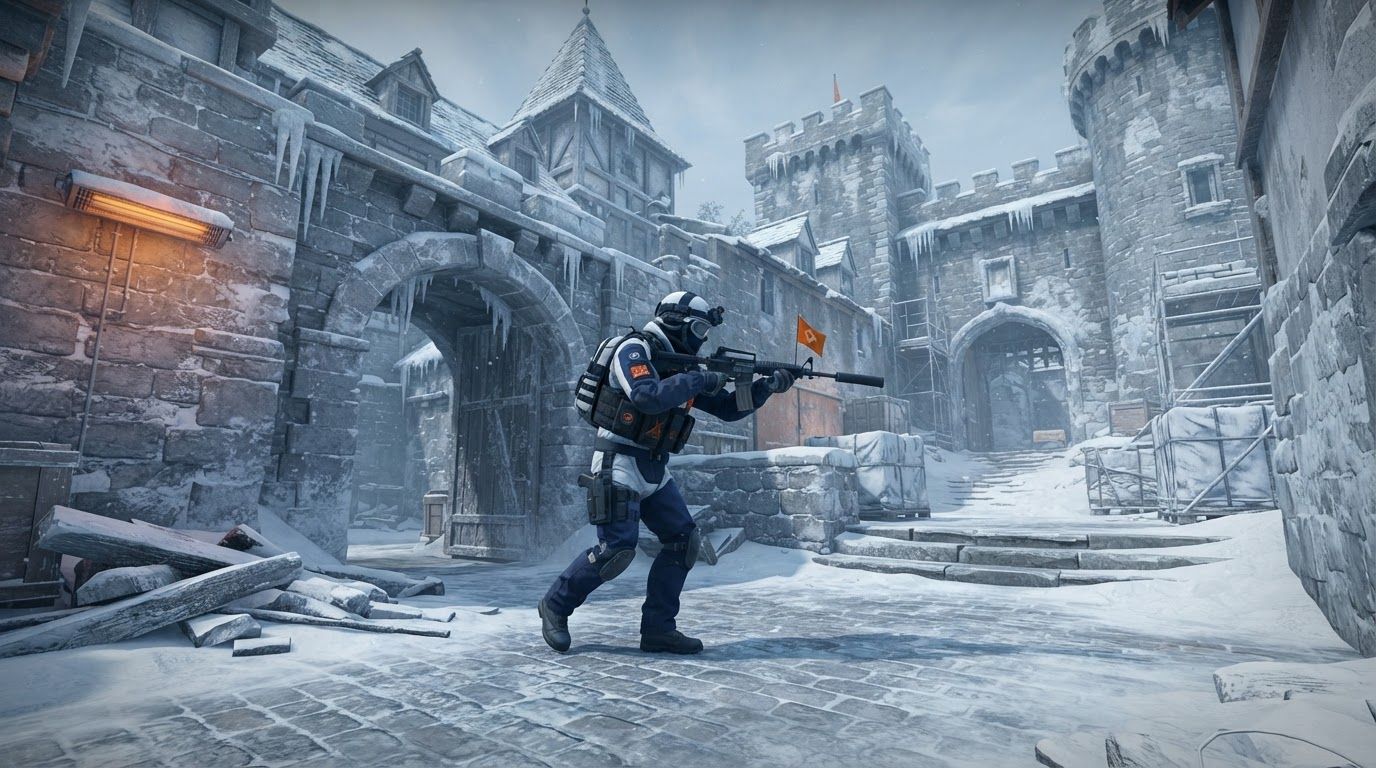
The Cobblestone rework is forcing teams to think about their map pools before it can even affect a Singapore Major veto directly. With Valve describing Cobblestone as completely overhauled and indicating that it is likely to enter the Active Duty pool after Singapore, the immediate challenge is not mastering an old map from memory; it is deciding how much preparation a new, uncertain map deserves while a Major is close.
For teams, analysts, and serious Counter-Strike players, the key takeaway is straightforward: Singapore preparation remains centered on the current event pool, but Cobblestone is already changing the risk calculation for the events that follow. Its snowy look, retained landmarks, and altered B Halls connection create a familiar-but-different environment that can quickly reshape comfort picks, permanent bans, and the value placed on flexible map pools.
How the Cobblestone rework is changing veto strategy
Direct answer: Cobblestone is unlikely to be a direct Singapore Major veto map if it joins Active Duty only after the event, but its rework is already affecting preparation. Teams must evaluate the new layout early, because a post-Singapore pool change could punish narrow map pools and make Cobblestone an early ban or volatile decider in future series.
The biggest strategic point is timing. Valve has said Cobblestone is likely to join the Active Duty pool after the Singapore Major, so teams should not treat it as a confirmed immediate factor in Singapore matches. Yet the arrival of a heavily revised map during final Major preparation means staff cannot simply file it away for later.
Veto planning is built around more than the maps that can be picked today. It also reflects what a roster will need to solve next, what opponents are already practicing, and how much long-term confidence exists behind a team’s current map pool. A potential Cobblestone addition introduces an extra decision into that process: whether to use limited time now to build a baseline, or preserve all attention for the maps that matter at Singapore.
That decision is especially relevant because Singapore Major invites are locked to the November VRS update. According to HLTV, that ranking snapshot will be used to send invites, placing invited teams firmly into final-event mode. In that setting, coaches are unlikely to abandon their Singapore work for a speculative project, but they also cannot ignore a map that may become an Active Duty requirement shortly afterward.
- For Singapore: the priority remains the event-eligible pool and established opponent preparation.
- For the period after Singapore: Cobblestone can become a major source of uncertainty in bans, picks, and decider calculations.
- For broad map pools: the rework rewards teams that can assess a new map without allowing that work to disrupt immediate competitive goals.
This does not mean Cobblestone will automatically become everyone’s best map or worst map. It means the map creates a new unknown, and unknowns carry real veto value. Until teams build meaningful official experience, an opponent’s claimed comfort on Cobblestone will be difficult to verify, making early decisions around it more conservative.
What changed on snowy Cobblestone, and why the layout matters
Valve’s overhaul does not erase Cobblestone’s identity. The updated version has snow and retains recognizable locations including Drop, Chicken Coop, and B Long. Those surviving landmarks matter because experienced players can orient themselves quickly, while teams can use established callout language as a starting point rather than rebuilding communication from nothing.
The central tactical change reported by HLTV is in B Halls. Instead of forcing a full rotate back through A Yard, B Halls now connects toward A. That adjustment is important not because one connector automatically determines a map’s balance, but because it changes the routes available between key areas of the map.
Rotation routes can alter the value of information
On a competitive map, timing and access routes shape how teams interpret information. A defender hearing pressure at one site must decide whether it is a committed hit, a fake, or an attempt to draw rotations. When the architecture offers a different connection between B Halls and A, the time, safety, and purpose of certain movements may change.
That can affect the questions teams ask in review:
- Can a side shift resources without exposing a critical route?
- Can attackers create more credible multi-area pressure before committing?
- Which positions gain value from watching transitions rather than holding a site entrance?
- Does the new route make late-round reads harder, easier, or simply different?
No reliable answer should be assumed before extensive play and analysis. The documented connector change supports the conclusion that rotation timing and site access are likely to be different; it does not, by itself, prove that either side will be favored. Teams will need demos, internal review, matchmaking experience, and eventually official play before assigning durable labels such as CT-sided or T-sided.
Familiar callouts do not equal familiar systems
There is a temptation to view Cobblestone as a recovered comfort map because of its history and returning landmarks. That is a risky shortcut. Familiar names can make the first days of practice feel efficient, but the systems around those names may no longer function the same way.
A set play built around Drop, for example, depends on more than recognizing Drop. It depends on surrounding sightlines, timing windows, available support, likely rotations, and how opponents can respond. The same is true of holds near Chicken Coop or pressure around B Long. The visual memory of the place is useful, but it is not a substitute for proving that old assumptions still hold.
Why Cobblestone’s history still influences team confidence
Cobblestone arrives with unusually deep Counter-Strike history. HLTV notes that the map first appeared in Counter-Strike beta in 2000, returned to modern Counter-Strike in 2013, became one of the most-played maps in the professional scene in 2016, and left Active Duty in 2018. That legacy explains why its reappearance immediately attracts more scrutiny than a completely unfamiliar competitive map might receive.
Veteran players, long-time viewers, and coaches who have worked through earlier Cobblestone eras may recognize broad strategic themes, old pressure points, and the map’s distinctive pacing. Community conversation also has a reference point: people can compare the rework with remembered versions rather than trying to describe an entirely new competitive space.
Still, history is best used as context, not evidence of present-day strength. A player who was comfortable on earlier Cobblestone may adapt faster to the map’s language and landmarks. That player does not automatically have a current tactical advantage. The snowy rework and the changed B Halls route mean any prior playbook requires validation.
Legacy can create both preparation advantages and blind spots
A team with Cobblestone experience may initially benefit from quicker communication. Old labels can reduce friction in early sessions, and familiar areas may help players identify which positions they want to test first. That can be valuable when the calendar is compressed.
The opposite risk is overconfidence. Teams can waste practice if they import legacy defaults, utility concepts, or rotations without checking whether the new version supports them. The best approach is to use historical knowledge to create a testing list, not to declare conclusions in advance.
- Use historic familiarity to establish common language.
- Re-test every route and rotation that depends on the updated geometry.
- Separate remembered map identity from present-day tactical evidence.
- Record what is observed in the rework rather than relying on reputation.
This distinction matters in vetoes. An opponent may assume that a roster with older Cobblestone experience is comfortable and ban accordingly. That assumption could be correct, but it could also hand that roster a useful strategic image before anyone has shown a developed official game on the reworked map.
Singapore Major preparation leaves little room for a full Cobblestone build
The Singapore Major runs from November 24 to December 13, 2026. With the overhaul arriving in the same broader competitive window and with Major invites tied to the November VRS update, teams do not have months of official sample size to establish exactly where Cobblestone belongs in the professional hierarchy before Singapore.
That is why a veto-first lens makes sense. Teams preparing for a Major must protect the quality of their immediate work: opponent scouting, map-specific anti-strats, role clarity, pistol-round preparation, and the countless details required for the maps they can actually play at the event. A complete Cobblestone campaign would compete for time with all of that.
At the same time, ignoring the map entirely creates another problem. Once Singapore ends, the expected Active Duty transition could arrive quickly enough that teams with no baseline are forced to make their first serious decisions under competitive pressure. The sensible middle ground is not a full commitment or total avoidance. It is controlled reconnaissance.
A practical split between Major work and future-proofing
For professional teams, the exact allocation will depend on their current map-pool health and practice access. A roster with stable picks, a reliable ban, and strong support staff can likely dedicate more structured attention to Cobblestone. A roster still trying to fix immediate Singapore weaknesses may need to keep its exploration lighter.
A grounded early process could look like this:
- Document the rework: identify changed paths, retained landmarks, and the implications worth testing around B Halls and A access.
- Play controlled sessions: use scrims or internal work to establish initial callouts, roles, and basic reactions to pressure.
- Review uncertainty, not just highlights: note which rotations, retakes, and late-round decisions remain unclear.
- Preserve Singapore priorities: avoid allowing a future map to displace essential preparation for the confirmed Major environment.
- Reassess after the event: once the pool status and early competitive direction are clearer, decide whether Cobblestone should become a pick, a permaban, or a map to leave open selectively.
This is not a shortcut to map mastery. It is a way to prevent the team from entering the post-Singapore period with no shared understanding at all. The goal before the Major is to reduce surprise, not to manufacture certainty that the available evidence cannot support.
Early Cobblestone veto models will reward caution and flexibility
When a revised map first becomes eligible for top-level competition, its value in a veto is often driven by uncertainty as much as proven quality. Teams may not know whether an opponent has spent serious time on it, whether their public matchmaking activity reflects genuine preparation, or whether their preferred approach is durable against organized opposition.
That makes an early Cobblestone veto less like a normal choice between well-understood maps and more like a risk-management decision. A team may choose to ban the map because it lacks information, even if it has not concluded that Cobblestone is intrinsically bad for its roster. Another team may leave it open precisely because it believes uncertainty can hurt an opponent more.
The likely early approaches
Several approaches are plausible once Cobblestone becomes an Active Duty factor. None is universally right, and each depends on the rest of a team’s pool.
- Early ban: remove Cobblestone before an opponent can turn unknown preparation into a surprise pick. This lowers volatility but may force difficult choices elsewhere in the veto.
- Conditional float: leave the map available against teams that appear equally untested, while banning it against rosters believed to have invested heavily. This demands good scouting and disciplined judgment.
- Fast adoption: build enough confidence to use Cobblestone as a proactive pick. The upside is potential first-mover advantage; the downside is revealing an incomplete system.
- Decider acceptance: avoid picking the map but prepare enough to survive it as a decider. This can be useful for deep map pools, though it is dangerous if the team’s understanding remains shallow.
The important point is that Cobblestone will affect the rest of the veto even when it is banned. If a team spends its first ban on Cobblestone, another opponent comfort map may remain available. If it leaves Cobblestone open, it may gain freedom to target a rival’s established strengths but accept a less predictable series.
That is why narrow comfort zones are particularly exposed. The inference from Valve’s expected post-Singapore Active Duty move and the compressed calendar is clear: a roster that relies on a small set of trusted maps could be pressured into more uncomfortable veto branches. Cobblestone does not need to be a dominant map to create that pressure. It only needs to become credible enough that opponents cannot dismiss it.
Public matchmaking gives Cobblestone a fast community test bed
Valve has placed Cobblestone in Casual, Competitive, Wingman, Retakes, and Deathmatch matchmaking. That broad availability matters because the map is not restricted to private professional practice. Players can begin learning its routes, positions, and rhythm immediately across several modes, while teams can gather informal impressions and test basic communication.
For the wider Counter-Strike community, that is an invitation to participate in the map’s early understanding. Casual players can relearn the environment, competitive players can start refining callouts and setups, and content creators or community analysts can compare the new flow with the map’s legacy identity. For teams, widespread access means useful ideas and public habits can emerge quickly.
It also means public play has limits. Matchmaking and professional Counter-Strike ask different questions. A pug can reveal that a route feels fast, confusing, exposed, or convenient. It cannot reliably prove that a structure works against a prepared opponent with coordinated utility, planned rotations, and opponent-specific reads.
How to use public data without overrating it
The healthiest use of early matchmaking information is as a hypothesis generator. If many players gravitate toward one area, that can tell a team where to test pressure. If a route repeatedly creates confusion, that may flag a communication issue worth solving. If players develop common callouts, those can help create a shared baseline.
But teams should avoid turning public trends into conclusions about professional balance. A public match does not provide an official sample, and early behavior is especially likely to change as people learn the rework. The map’s presence in multiple matchmaking modes accelerates discovery; it does not settle strategic debates.
That distinction applies to viewers as well. It is reasonable to watch early Cobblestone games for clues about movement, contested areas, and recurring mistakes. It is less reliable to declare a permanent side bias or a guaranteed veto status before organized teams have had time to test and counter-test the map.
Why the Singapore ecosystem has made the conversation immediate
The Cobblestone update did not land in isolation. The same patch also included the PGL Singapore 2026 Major Hub, Viewer Pass, Pick’Em Challenge, and related tournament items, directly linking the update to the event’s competitive ecosystem. That connection helps explain why discussion moved so quickly from visual changes to Major preparation and future map-pool consequences.
HLTV’s live Singapore Stage 1 coverage includes “veto simulation,” reflecting how quickly map-pool discussion is being framed through series decisions. Even if Cobblestone is not an immediate event map, veto analysis is already the natural language for understanding what a likely post-Major addition could do to teams.
HLTV Confirmed also dedicated an episode to reacting to the new Cobblestone and previewing the Singapore Major. That does not settle the map’s competitive status, but it is a strong sign that the rework has entered top-tier strategic discussion rather than remaining only a nostalgia story.
What viewers should watch after Singapore
The first meaningful signs will not necessarily be dramatic highlight rounds. More revealing evidence may come from which teams invest in the map, when it receives a first ban, whether it appears as a confident pick, and how frequently it survives to a decider. These choices reveal perceived risk as well as raw tactical preference.
- Watch whether teams ban Cobblestone before targeting established opponent picks.
- Track whether squads with broad pools leave it open more often than teams with narrow pools.
- Look for differences between early public confidence and actual organized execution.
- Pay attention to how teams respond to the B Halls-to-A connection in rotations and late rounds.
Those observations will be more useful than trying to settle the map’s place from its first few public impressions. Early Counter-Strike map discourse often moves quickly; reliable veto conclusions take repeated, organized evidence.
What teams and players should take from Cobblestone’s return
The Cobblestone rework is strategically important because it combines familiarity with disruption. Players recognize Drop, Chicken Coop, B Long, and the map’s broader historical identity. At the same time, the snow-covered overhaul and B Halls connection toward A ensure that recognition cannot safely become complacency.
For teams, the best immediate response is measured preparation. Keep Singapore Major work focused on the confirmed event environment, establish a working understanding of Cobblestone, and avoid making hard claims before the map has a meaningful competitive record. For players and fans, use the new matchmaking availability to learn the map, share grounded observations, and distinguish between legacy memories and the rework’s actual behavior.
The coming veto question is not simply whether Cobblestone will be good or bad for a given roster. It is whether that roster can afford to let a new Active Duty variable dictate the rest of its map-pool decisions. Teams that build flexible processes now will be better placed to answer that question once Singapore ends and Cobblestone’s competitive role becomes clearer.
Singapore remains the immediate priority, but the post-Major map-pool conversation has already begun. Treat the new Cobblestone as a developing strategic problem: learn the changed routes, respect the uncertainty, and watch how bans, picks, and deciders reveal which teams are ready for the next veto cycle.