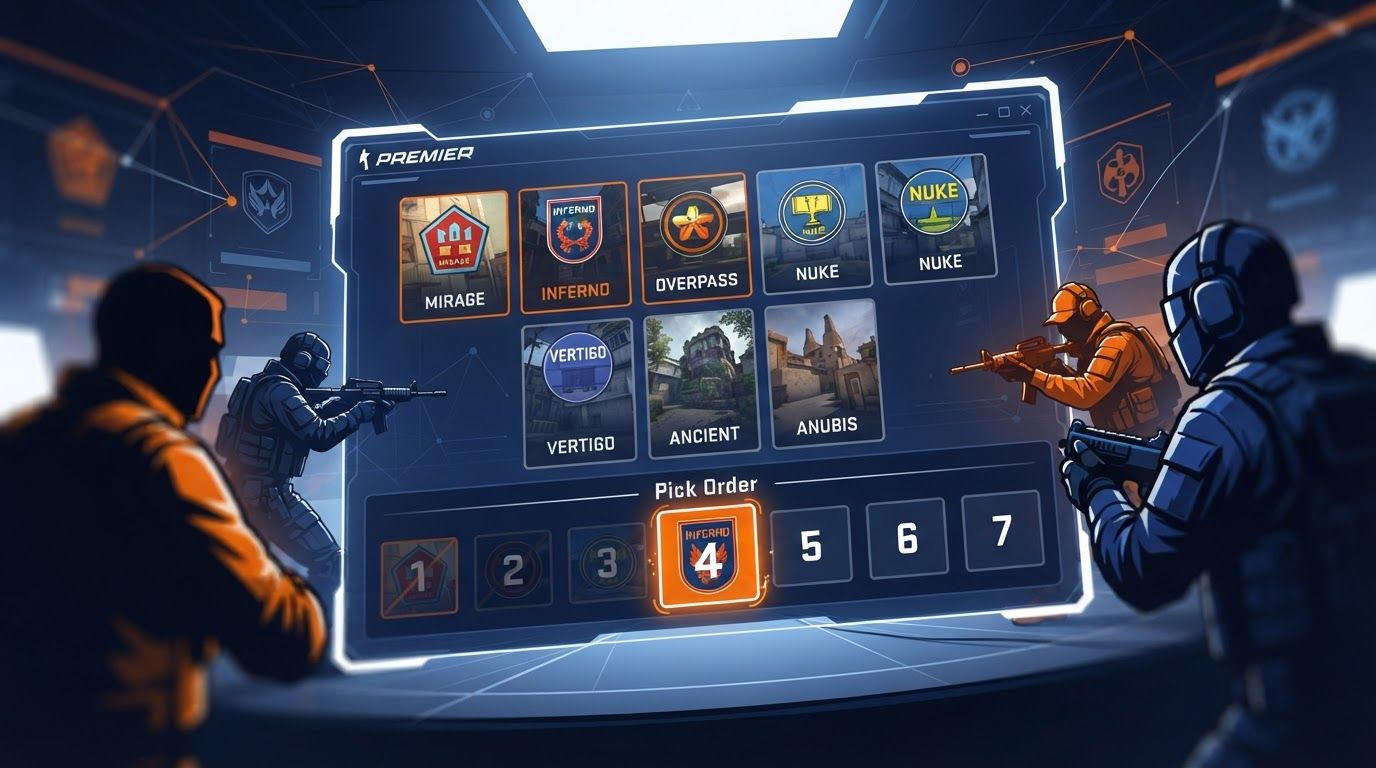
Premier map pick order has changed from a veto exercise into a probability problem. With the September 23, 2026 Rush Hour update, teams no longer ban their way down to a single map; they build a four-map candidate pool, and the game randomly selects the map that will be played.
That makes comfort picks, weak maps, and middle-round drafting decisions matter in different ways. Players who treated Premier as a race to protect Mirage or Dust2 now need a broader plan: understand the new order, prepare for several plausible outcomes, and make picks that remain useful even when the final draw is out of their hands.
How the revamped Premier map pick order works
The new Premier flow is straightforward in principle, even if its strategic consequences are still being worked out by the community. Team 1 makes the opening pick, Team 2 makes two consecutive picks, Team 1 makes the final pick, and CS2 randomly selects one of the four chosen maps for the match.
Direct answer: The revamped Premier map pick order is Team 1 pick, Team 2 pick twice, Team 1 pick again, then a random draw selects one of the four maps. It replaces map bans with probability-based planning.
This is a structural change, not a small adjustment to the old veto screen. Under the previous ban-down approach, the practical objective was often denial: remove maps the other side wanted, preserve a favorable option, and narrow the decision until one map remained. The new system instead asks both teams to assemble a pool that they can live with.
Valve’s stated aim was to reward players who put time into learning particular maps, rather than allowing a stronger comfort map to be vetoed away before a match starts. That intent helps explain why the order includes four picks and a random outcome. A team’s work on a map can now matter even if it cannot force that map as the final destination.
- Team 1: makes the first pick.
- Team 2: makes the next two picks in succession.
- Team 1: makes the fourth and final pick.
- CS2: randomly selects one map from the resulting four-map pool.
For players entering Premier with an old-veto mindset, the most important adjustment is simple: a pick is no longer a guarantee. It is an attempt to improve the collection of possible maps. Conversely, a map you would once have banned may now enter the pool because the other team values it, because the pick order lets them introduce it, or because it supports a broader strategy.
Why Team 2’s consecutive picks are reshaping Premier strategy
Community coverage quickly focused on the center of the sequence, and for good reason. Team 2 receives two consecutive picks, giving it the only uninterrupted pair of decisions in the Premier map pick order. Those choices can heavily shape the four-map pool before Team 1 gets its final response.
Team 1 still has meaningful bookends: it starts the process and closes it. The first pick can establish a preferred direction, while the final pick can add another map after seeing Team 2’s two selections. But neither bookend gives Team 1 full control over the map that loads, because the game makes the final random selection.
The middle pair creates the clearest leverage
Two consecutive picks allow Team 2 to make related decisions without immediately revealing the full plan to an opposing response. In practical terms, that means Team 2 can try to make the eventual pool more favorable across multiple possible draws rather than focusing on a single forced battleground.
The value of that leverage is contextual. A team may use the pair to select two maps it has prepared, to add maps it believes are uncomfortable for the opponent, or to avoid making its pool dependent on one narrow comfort pick. None of those choices guarantees the final map, but both middle selections influence the available outcomes at once.
Team 1’s response must be resilient, not reactive
After Team 2 takes its pair, Team 1 has one final decision. The mistake is to view that last pick as a way to “fix” the entire pool. One selection cannot erase the two middle picks, and it cannot override the random draw.
A more grounded approach is to ask whether the final pick improves Team 1’s position across the whole set of possibilities. If it only looks attractive when one exact map is selected, it may be a fragile choice. If it adds a map the roster can competently play while reducing reliance on a single comfort outcome, it better fits the new format.
Analytical breakdowns have also pointed out that the real advantage is not yet reducible to one settled rule. It depends on how frequently teams duplicate picks and on how the game’s randomization behaves in those situations. Until there is more public evidence, players should be cautious about treating either the first-and-last positions or the consecutive middle picks as automatically decisive in every match.
Map depth matters more than veto denial in Premier
The central Premier strategy shift is from denial to map depth. Before Rush Hour, teams could often prioritize removing the maps they disliked most or the maps they feared most from an opponent. In the new framework, a roster benefits from being playable on several maps because several maps can remain live until the final draw.
Map depth does not mean every player must become equally strong everywhere overnight. It means the team needs enough shared preparation that a random outcome does not immediately decide the match before the pistol round. That preparation includes knowing the map’s broad structure, having usable communication, and agreeing on a basic approach instead of relying on improvised calls.
What “playable” preparation should mean
Players often confuse a favorite map with a prepared map. A favorite may be the place where an individual has the most confidence, but Premier’s new structure rewards options the whole stack can execute under pressure. A playable map is one where the group understands enough to make coherent decisions after the opening rounds reveal how the opponents approach the game.
- Identify the maps your group can already play with reliable communication.
- Separate true weaknesses from maps that are simply less familiar than your favorite.
- Build a minimal shared plan for weaker but likely maps instead of leaving them entirely unprepared.
- Review which picks repeatedly create uncomfortable pools after your Premier matches.
- Adjust priorities as the group’s actual preparation changes, not just because a map has a reputation.
This is especially relevant for mixed-skill friends, solo-queue players, and loose stacks. A highly specialized player may still have a strong individual preference, but the team’s map pool should reflect collective readiness. A map choice that looks excellent for one player can be a poor probability play if the other four lack confidence or common language on it.
The trade-off is real. Spreading practice across maps can reduce the time available to perfect one signature pick. Yet the new Premier map pick order makes a single-map identity less reliable as a matchmaking plan. A team does not need to abandon its strongest map; it needs to stop treating that map as the only outcome worth preparing for.
Mirage and Dust2 dominance explains the change
The old selection environment was notably concentrated around familiar maps. In one community-tracked pre-update sample, Mirage accounted for 26.3% of Premier map selections and Dust2 accounted for 25.9%. Together, those two maps made up more than half of the matches in that sample.
The same dataset showed a substantial drop beyond those two familiar choices: Inferno had 11.3%, Ancient 11.2%, Nuke 10.5%, and Cache 6.6%. Those figures illustrate the imbalance the redesigned system was intended to address. A map pool can offer several options, but the practical experience remains narrow when players repeatedly navigate toward the same two maps.
- Mirage: 26.3% in the cited pre-update community sample.
- Dust2: 25.9% in that sample.
- Inferno: 11.3%.
- Ancient: 11.2%.
- Nuke: 10.5%.
- Cache: 6.6%.
These figures should not be read as an official Valve ranking or as a promise that the new system will distribute matches evenly. They are a pre-change community-tracked snapshot. Their value is in showing why a ban-centered process could repeatedly favor entrenched comfort choices and leave the rest of the pool underrepresented.
For Mirage and Dust2 specialists, the implication is not that either map suddenly becomes a bad choice. Both may remain important selections because many players know them well. The difference is that their presence must be evaluated as part of a four-map pool. A team that picks one familiar map but has no plan for the other plausible draws is only partly prepared.
A healthier pool is not the same as a perfectly even pool
Players should also avoid overpromising what a random-selection system can accomplish. Valve’s goal was to value map learning and prevent a comfort map from being automatically vetoed away, not to guarantee identical play rates for every map. Team preferences, pick behavior, duplicate selections, and the random draw can all affect what players actually see.
That distinction matters when discussing whether the update has “worked.” More varied matches may be one possible outcome, but public post-update statistics remain limited. The early strategic case for map depth is strong because of the new rules themselves; exact claims about long-term map frequency need more than early anecdotes.
How to make better picks under the pick-and-randomize system
Good Premier drafting now begins before the queue pops. The most useful habit is to decide what your group is willing to play, not merely what it wants to force. That turns the pick screen from a last-second argument into a controlled decision about risk.
Start with your team’s realistic map band
Create a simple internal classification: maps the group actively likes, maps the group can play competently, and maps that create avoidable problems. The point is not to create a rigid public tier list. It is to make sure the person clicking a pick understands whether a selection represents a genuine team option or only a personal preference.
When the opening pick arrives, use the information you have, but do not assume you can steer the match all the way to that map. The opening selection is valuable because it places one option into the candidate pool. It should be a choice you would be comfortable seeing after the random draw, rather than a symbolic declaration that becomes useless if another map is selected.
Read Team 2’s double pick as pool construction
When Team 2 chooses twice, focus on the shape of the pool that is emerging. Ask which maps are now possible, which of them your group can handle, and whether your final choice should add stability rather than chase a perfect counter. The two picks may reveal a preference, but their larger importance is that they create two possible outcomes at once.
Do not mistake this for mind reading. Opponents may choose maps for many reasons, and early community reaction shows players do not agree on which maps the system favors. The reliable information is the selected pool, not an imagined certainty about why the opponent made each choice.
Use the last pick to reduce unacceptable outcomes
Team 1’s last pick is an opportunity to make the total set more tolerable. In a coordinated group, briefly identify the weakest remaining possible outcome and decide whether the final selection should add a stronger shared option. The goal is to finish with a pool in which every selected map has a workable baseline plan.
Because the final choice is random, this approach is more robust than trying to predict one exact result. It also aligns with the larger design change: Premier now rewards teams that invest time in maps rather than teams that only excel at excluding them.
Think of each pick as changing the menu of possible matches, not as locking in the match you want. The best selection is usually the one your team can justify across the whole pool.
Prepare for Cache and the current Premier map pool
The drafting overhaul did not arrive in isolation. Earlier in 2026, a Premier season update added Cache and removed Overpass from the broader Premier map pool. That pool change matters because map preparation is only useful when it reflects the maps players can actually encounter in Premier.
Cache’s place in the pre-update community sample was 6.6%, lower than the shares listed for Inferno, Ancient, and Nuke. Under a system designed to give map investment more weight, players have a stronger reason to move beyond the most habitual choices and establish a practical Cache baseline if it is part of their Premier environment.
At the same time, Overpass preparation should not be treated as a current Premier drafting answer after its removal from the pool. Players can still value their prior experience on any map, but their Premier practice time should correspond to the active pool rather than to an outdated veto routine.
Prioritize preparation without chasing false certainty
A sensible order is to protect the maps your group already plays well, then improve the maps that repeatedly make your candidate pools uncomfortable. That is more actionable than trying to identify a single universally correct pick order. The correct decision varies by team composition, shared experience, and the choices that have already been made in the sequence.
- Keep your strongest team maps sharp, because they can still enter the candidate pool.
- Bring weaker active-pool maps to a usable baseline so random selection is less punishing.
- Discuss Cache as a current Premier consideration rather than assuming older pool habits still apply.
- Avoid spending Premier-specific planning time around Overpass as though it remains in the active pool.
- Revisit your priorities after real matches reveal communication or preparation gaps.
This is a practical community-level benefit of the new system: it encourages map conversations that are more specific than “ban this” or “pick that.” A team can identify why a map feels weak, decide what minimum work would make it playable, and test whether that preparation changes future drafting decisions.
Early Premier reactions reveal the limits of the new format
Reaction to Rush Hour’s Premier changes has been sharply mixed. Some players see the pick-and-randomize approach as a meaningful way to reward map preparation and reduce the power of pure comfort-map denial. Others argue that it can still send players to unpopular maps more frequently than they would choose on their own.
Both views can coexist because the update changes control rather than removing uncertainty. Players have more reason to invest in several maps, but they also surrender the ability to guarantee the final battlefield. For a group that enjoys variety and has broad preparation, that can feel like a positive challenge. For a player who queues around one or two familiar maps, it can feel like lost agency.
What cannot yet be concluded
Public post-update statistics are still limited. Most early conclusions come from player reporting, match observations, and community analysis rather than official Valve data. That means it is too soon to claim a verified new map-frequency hierarchy, a proven advantage for one pick position, or a measured long-term effect on every map in the pool.
The exact role of repeated selections also deserves restraint. Community analysis notes that the advantage of the order depends partly on how often teams duplicate picks and how RNG behaves. Until the available evidence is clearer, players should test strategies in their own matches and distinguish recurring experience from a universal rule.
Useful alternatives for different queue styles
There is no single replacement for the old veto mentality. A regular five-stack can hold a short pre-queue discussion and maintain shared map notes. A duo or trio can agree on a few maps where communication is dependable, while accepting that strangers may bring different preferences. Solo players have less control over coordination, so personal map familiarity across the active pool becomes even more valuable.
The common thread is flexibility. The system does not require every player to love every map. It asks them to recognize that Premier now produces a range of possible maps and that preparation, not only denial, determines how ready they are when the draw is made.
Build a Premier map plan that survives the random draw
A durable plan is less glamorous than hunting for a guaranteed winning pick, but it fits the rules Valve introduced on September 23, 2026. Keep a clear view of the active pool, make selections your team can actually play, and treat Team 2’s consecutive picks as a major moment in the process. Then use Team 1’s final pick to improve the overall pool instead of trying to force an outcome the game will ultimately randomize.
After each session, review the match in concrete terms. Did the map pool contain options your group had prepared? Did a pick expose a communication gap? Did your team rely too heavily on Mirage, Dust2, or another comfort choice? Those questions turn the new Premier map pick order into something you can improve around, rather than something that merely happens to you.
The key takeaway is that Premier strategy now rewards breadth with purpose. Mirage and Dust2 may remain familiar priorities, while Cache and the rest of the active pool demand more attention than a ban-down system encouraged. The teams best positioned for the new format are not necessarily the ones with one unbeatable map; they are the ones with enough map depth to compete when any selected option becomes the match.
Keep following your own match outcomes alongside community analysis as more post-update evidence becomes available. For now, make every pick with the four-map pool in mind, practice the maps your stack can realistically face, and let preparation,not hope for a perfect veto,guide your Premier decisions.